19 s of calling song; male from Los Angeles Co., Calif.; 25.8°C. (WTL581-25)
Click on sound bar to hear graphed song.
Sound spectrogram of 2 s of calling at 25.8°C (from WTL581-25). Dominant frequency 3.9 kHz.
Click on spectrogram to expand its spectrographic image
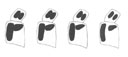
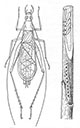
Length 13–15 mm. Black marks on second antennal segment confluent, contiguous, or separated by no more than one-third the width of the inside mark; pronotum never black or with black or dusky stripes.
Similar species:
Four-spotted and fast-calling—black marks on second antennal segment separated by more than one-third width of the inside mark.
Habitat:
Prairies, old fields, crops.
Season:
Two generations annually in most areas; probably one in the most northern populations and perhaps more than two in the most southern ones. In central Ohio, the first generation adults occur in July and early August, and the second generation ones occur in September and October In southern Arizona, adults have been collected from early February to mid December.
Remarks:
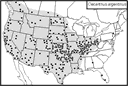
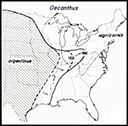
This species has apparently spread eastward in the past 50 years, probably in response to the extensive prairielike habitats produced by agriculture. The five herb-inhabiting species of the Oecanthus nigricornis species group—the prairie, four-spotted, black-horned, Forbes's, and fast-calling—are the most commonly encountered and the most difficult to identify tree crickets.