common name: bean leafroller
scientific name: Urbanus proteus (Linnaeus) (Insecta: Lepidoptera: Hesperiidae)
Introduction - Distribution - Description - Life Cycle - Hosts - Damage - Management - Selected References
Introduction (Back to Top)
The larva of bean leafroller, Urbanus proteus (Linnaeus) is a common, late summer pest of beans, and occasionally soybeans. It is especially common in home gardens and on some weeds, particularly Dixie tick trefoil (Desmodium tortuosum). If bean leaves are rolled, or leaf edges look ragged, check for bean leafroller larvae. The adult, a longtail skipper, is commonly seen feeding on nectar of flowers.
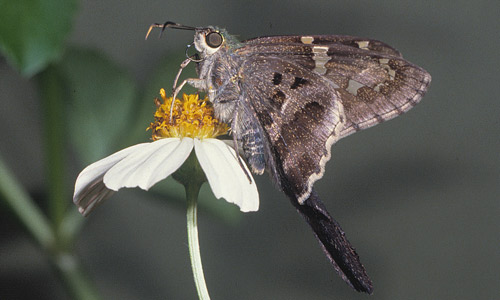
Figure 1. Adult bean leafroller, Urbanus proteus (Linnaeus). Photograph by Jim Castner, University of Florida.
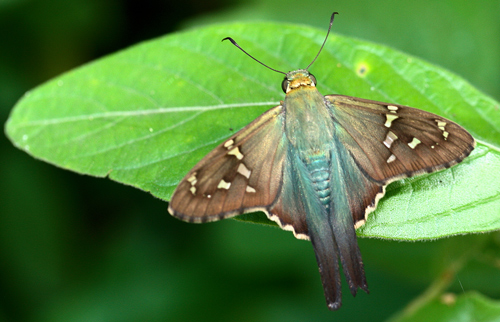
Figure 2. Adult bean leafroller, Urbanus proteus (Linnaeus). Photograph by Don Hall, University of Florida.
Distribution (Back to Top)
The range of the bean leafroller includes the southern United States and all of Mexico, Central America and the Caribbean, and South America south to Argentina.
In the United States, the bean leafroller is found throughout Florida and in coastal areas from South Carolina west to eastern Texas. It annually invades (extends its range) to most of the southeastern states, and regularly invades the southernmost areas of the southwest U.S. However, This species cannot tolerate prolonged freezing temperatures, and in the United States it persists only in the southern coastal plain, perhaps only in southern Florida.
Description (Back to Top)
Adult: The bean leafroller adult is fairly large, measuring about 50 mm in wingspan. The most pronounced feature is the prolonged extensions, or "tails," of the hind wings. As a result of these extensions, the adult butterfly is commonly known as the "longtail skipper." The forewings and hind wings are chocolate brown dorsally and pale brown ventrally. The forewings also are marked with five to seven square or rectangular spots, white above and light brown below. Green iridescent scales are present on the wings and body.
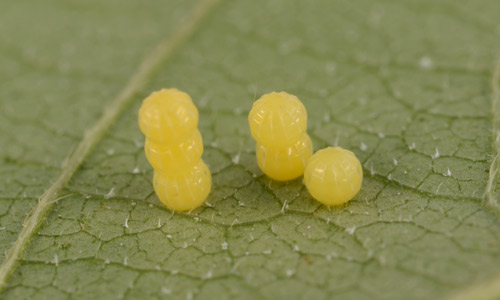
Egg: The eggs of the bean leafroller are deposited singly or in small clusters of two to six eggs on the lower epidermis of foliage. Initially the eggs are white in color, but soon turn yellow. The egg is a slightly flattened sphere, and measures about 1 mm in diameter. Eggs hatch in three to four days.
Figure 3. Eggs of the bean leafroller, Urbanus proteus (Linnaeus). Photograph by L.J. Buss, University of Florida.
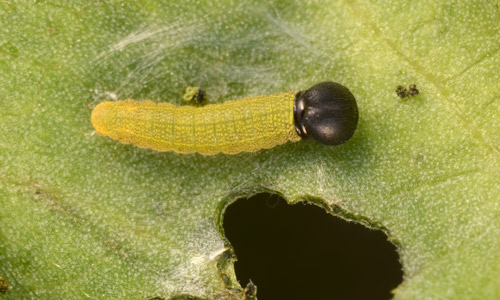
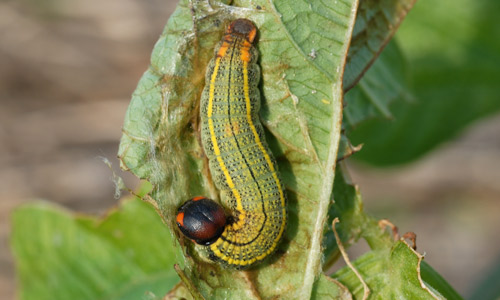
Larva: There are five larval instars, and 15 to 20 days are required for the larval stages. Initially the larva is yellowish with a brownish-black head and prothoracic shield. The head is quite large relative to the body, and remains this way throughout development. With the molt to the second instar the dorsal surface of the insect becomes marked with numerous small, black spots. Beginning with the third instar, lateral yellow lines become quite distinct. The last two instars are similar to the preceding: brownish-black head, black prothoracic shield, yellowish body sprinkled with black spots but lighter below, and yellow lateral lines. Also evident are orange spots on the head near the base of the mandibles, and red on the ventral portion of the thoracic segment. The body tapers sharply toward both the anterior and posterior ends.
Figure 4. First instar larva of bean leafroller, Urbanus proteus (Linnaeus), measuring only 4.5 mm (about 3/16 inch) in length. Photograph by Lyle J. Buss, University of Florida.
Figure 5. Mature larva of bean leafroller, Urbanus proteus (Linnaeus). Photograph by Lyle J. Buss, University of Florida.
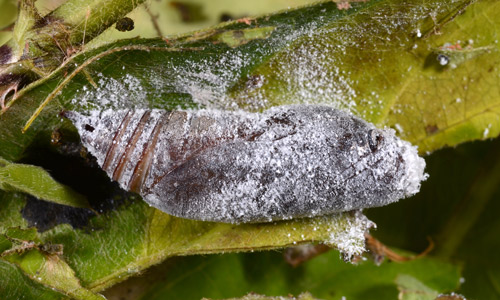
Pupa: The larva pupates on the plant, within the shelter formed by the larva from leaf material. The pupa measures about 20 mm in length. The pupa is yellow to brown, and is covered by a bluish-white pubescence. Duration of the pupal stage is seven to 20 days.
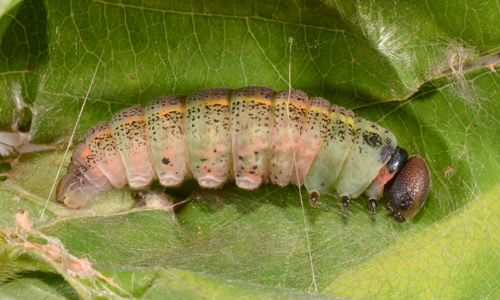
Figure 6. Prepupa of bean leafroller, Urbanus proteus (Linnaeus). This is the end of the caterpillar stage but it is beginning to thicken and shorten as it prepares to transform into a pupa. Photograph by Lyle J. Buss, University of Florida.
Figure 7. Pupa of the bean leafroller, Urbanus proteus (Linnaeus). Photograph by Lyle J. Buss, University of Florida.
Life Cycle (Back to Top)
The bean leafroller can complete its life cycle in about 30 days. It breeds in southern Florida throughout the year, but is relatively infrequent in northern Florida until June, and only becomes abundant late in the season, usually September-October. In Florida, large numbers of adults are frequently observed migrating southward in the autumn. They make a similar northward migration in the spring and summer, but it is less apparent.
Hosts (Back to Top)
The bean leafroller larva feeds on legume crops such as cowpea, lima bean, pea, snap bean and soybean. It is also known from wisteria, Wisteria spp.; Dixie tick trefoil, Desmodium spp.; butterfly pea, Clitoria spp.; and hog peanut, Amphicarpa bracteata.
Damage (Back to Top)
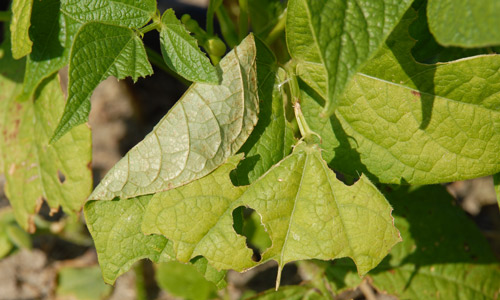
Larvae are defoliators, feeding only on leaf tissue of legumes. Initially the larva cuts a small, triangular patch at the edge of the leaf, folds over the flap, and takes up residence within this shelter. The larva leaves the shelter to feed, and lines the shelter with silk. These flaps are used until the third or fourth instar, when the larva constructs a larger shelter formed by folding over a large section of the leaf by webbing together two separate leaves. Again, the leaf fold is used for shelter, the larva leaving to feed. Larvae feed nocturnally.
Figure 8. Bean leafroller, Urbanus proteus (Linnaeus), leaf damage. Photograph by Lyle J. Buss, University of Florida.
Management (Back to Top)
Sampling. Populations are normally sampled by visual observation because the larvae are sheltered within leaf folds and difficult to dislodge by sweeping, and because the leaf damage caused by shelter-building activity is readily apparent.
Action threshold. Larvae consume about 190 sq cm of foliage during their development. Beans can tolerate up to about 30 percent leaf loss without reduction in yield, so about four larvae must complete their development on a "typical" bean plant with 2175 sq cm of foliage to inflict a damaging level of defoliation. Because about one-half of the individuals perish in each life stage, densities of 140 eggs or 70 first instar larvae per plant must occur to cause damage.
Chemical control. Most insecticides applied to the foliage are very effective for leafroller suppression. This should only be necessary for late-season bean crops. The microbial insecticide Bacillus thuringiensis currently is not recommended.
Biological control. In Florida, Chrysotachina alcedo (Loew) (Diptera: Tachinidae) was reared from larvae, and predation was observed by a Polistes spp. wasp (Hymenoptera: Vespidae) and Euthyrhynchus floridanus (Linnaeus) stink bugs (Hemiptera: Pentatomidae). Also, a nuclear polyhedrosis virus was found to infect and kill up to 40 to 50 percent of larvae late in the season when larvae were numerous.
Selected References (Back to Top)
- Capinera JL. 2001. Handbook of Vegetable Pests. Academic Press, San Diego. 729 pp.
- Cock MJW. 2015. Observations on the biology of skipper butterflies in Trinidad, West Indies: Urbanus, Astraptes and Narcosius (Hesperiidae: Eudaminae). Living World: Journal of the Trinidad and Tobago Field Naturalist’s Club. 2015: 1-14.
- Greene GL. 1970. Head measurements and weights of the bean leaf roller, Urbanus proteus (Hesperiidae). Journal of the Lepidopterist’s Society 24: 47-51.
- Greene GL. 1971. Economic damage levels of bean leafroller populations on snap beans. Journal of Economic Entomology 64: 673-674.
- Greene GL. 1971. Instar distributions, natural populations, and biology of the bean leaf roller. Florida Entomologist 54: 213-219.
- Greeney HF, Sheldon KS. 2008. Comments on larval shelter construction and natural history of Urbanus proteus Linn. 1758 (Hesperiidae: Pyrginae) in southern Florida. Journal of the Lepidopterist’s Society 62: 108-110.
- Nava DE, Para JRP. 2002. Development and soybean leaf consumption by Urbanus proteus proteus (L.). Scientia Agricola 59: 661-663.
- Quaintance AL. 1898. The bean leafroller. Florida Agricultural Experiment Station Bulletin 45: 55-60.
- Van Dam W, Wilde G. 1977. Biology of the bean leafroller Urbanus proteus (Lepidoptera: Hesperidae). Journal of the Kansas Entomological Society 50: 157-160.
- Young AM. 1985. Natural history notes on Astraptes and Urbanus (Hesperiidae) in Costa Rica. Journal of the Lepidopterists' Society 39: 215-223.