common name: crazy ant
scientific name: Paratrechina longicornis (Latreille) (Insecta: Hymenoptera: Formicidae)
Introduction - Synonymy - Distribution - Description - Life Cycle - Pest Status - Foraging and Feeding - Nest Sites - Management - Selected References
Introduction (Back to Top)
The crazy ant, Paratrechina longicornis (Latreille), occurs in large numbers in homes or out-of-doors. Ants of this species often forage long distances away from their nests, so nests are often difficult to control.
Figure 1. Dorsal view of a crazy ant, Paratrechina longicornis (Latreille), worker. Photograph by James Castner, University of Florida.
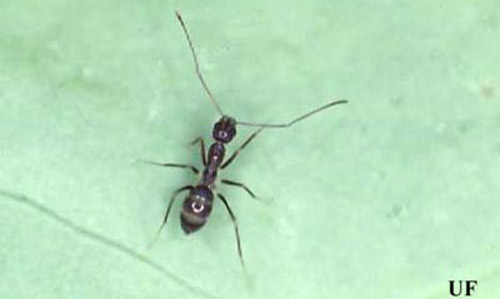
Its common name arises from its characteristic erratic and rapid movement, and habit of not following trails as often as other ants. However, while the term crazy ant is officially identified with this species, there are other closely related ant species that are also called crazy ants. At least one authority has suggested that Paratrechina longicornis receive the common name longhorned crazy ant to prevent it being confused with other species referred to as crazy ant. Other authorities have used the name black crazy ant (Watterer 2008).
Synonymy (Back to Top)
- Formica longicornis Latreille (1802)
- Prenolepis longicornis Roger (1863)
- Prenolepis (Nylanderia) longicornis Emery (1910)
- Formica vagans Jerdon (1851)
- Formica gracilescens Nylander (1856)
- Tapinoma gracilescens F. Smith (1858)
- Paratrechina currens Motschoulsky (1863)
- Paratrechina longicornis (Latreille) (1925)
(from Creighton 1950)
Distribution (Back to Top)
The crazy ant is an agricultural and household pest in most tropical and subtropical areas, and is a pervasive indoor pest in temperate areas. It has the ability to successfully survive in highly disturbed and artificial areas, including ships at sea. Since it can live indoors with humans, there is no limit to the latitude where it can exist. It has been reported from as far north as Sweden and Estonia, and as far south as New Zealand (Wetterer 2008).
The crazy ant is found in various parts of the world and is not native to the United States (Smith 1965). While found in tropical cities worldwide, it was thought to be of either Asian or African origin. (Trager 1984). Wetterer (2008) states that newer evidence points to its origin in Southeast Asia or Melanesia.
In the United States, the crazy ant has widespread population from Florida to South Carolina and west to Texas. It commonly is found in residences and warehouses over much of the eastern United States (Creighton 1950) and in California and Arizona (Trager 1984). Populations are also reported from Hawaii, Missouri, Virginia, New York and Massachusetts. In Canada, it has been reported in Quebec and Ontario (Wetterer 2008).
In fact, Wetterer (2008) argues that Paratrechina longicornis is the most "broadly distributed of any ant species." The only other species which he believes might contest this honor is the Pharaoh ant, Monomorium pharaonis.
Description (Back to Top)
The crazy ant is so morphologically distinctive that it is one of the few Paratrechina that is not consistently misidentified in collections (Trager 1984). The crazy ant worker is relatively small (2.3-3 mm). The head, thorax, petiole, and gaster are dark brown to blackish (Creighton, 1950); the body often has faint bluish iridescence. The body has long, coarse, scattered, suberect to erect, grayish or whitish setae (hair-like projections).
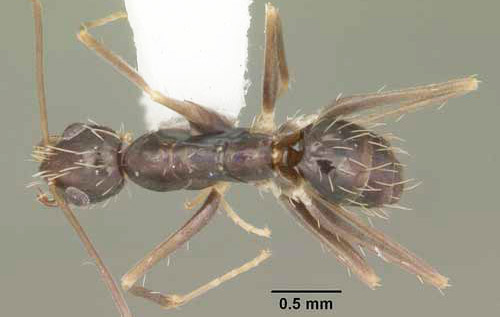
Figure 2. Dorsal view of a crazy ant, Paratrechina longicornis (Latreille). Ant collected in Florida, United States. Photograph by April Nobile, California Academy of Sciences.
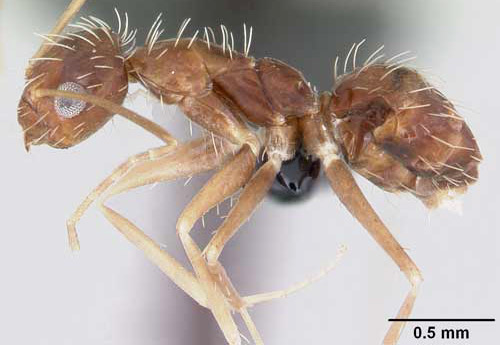
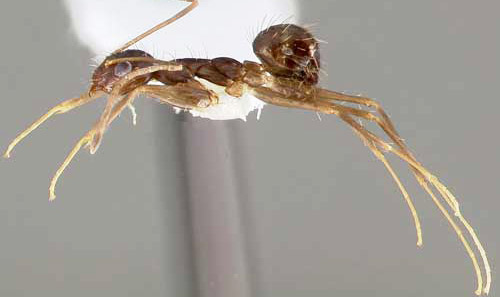
Figure 3. Lateral view of a crazy ant, Paratrechina longicornis (Latreille), showing the setae. Ant collected in Réunion. Photograph by April Nobile, California Academy of Sciences.
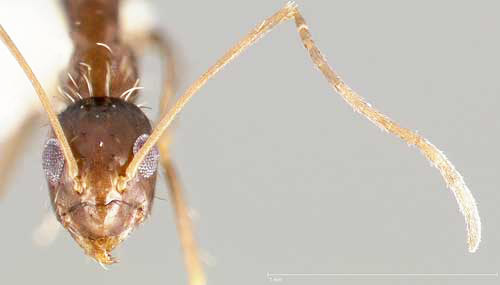
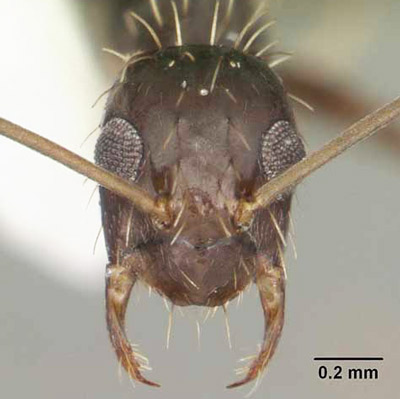
The antennae of the crazy ant have 12-segments without a club and are extremely long. The scape, the basal segment of the antenna, is extraordinarily long with the apex surpassing the posterior border of the head by at least one-half the scape length. Eyes are elliptical, strongly convex, and close to the posterior border of the head.
Figure 4. Frontal view of a crazy ant, Paratrechina longicornis (Latreille), showing the long, 12-segmented antenna and the position of the eyes. Ant collected in California, United States. Photograph by April Nobile, California Academy of Sciences.
Figure 5. Frontal view of a crazy ant, Paratrechina longicornis (Latreille), showing the long, 12-segmented antenna and the position of the eyes. Ant collected in Florida. Photograph by April Nobile, California Academy of Sciences.
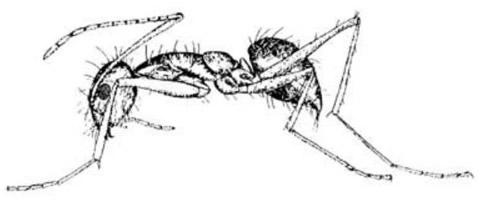
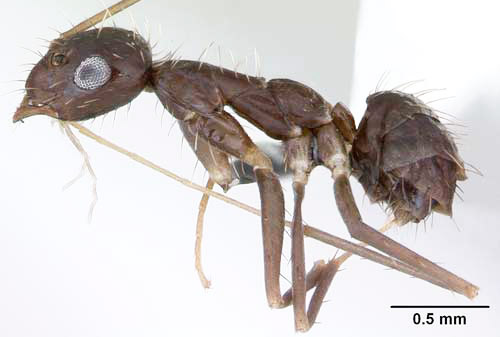
All workers in a crazy ant colony are monomorphic and have only one node between the propodeum and the gaster. Legs are extraordinarily long. The petiole is wedge-shaped, with a broad base, and has a slight forward tilt. A small, round, terminal orifice surrounded by a fringe of setae, the acedipore, serves for the application of venom both in defense and predation. The stinger is lacking but the crazy ant may bite an intruder and curve its abdomen forward to inject a formic acid secretion onto the wound.
Figure 6. Lateral view of a crazy ant, Paratrechina longicornis (Latreille). See wedge-shaped petiole and fringe of setae around terminal orifice.
Figure 7. Lateral view of a crazy ant, Paratrechina longicornis (Latreille), showing the petiole. Ant collected in California, United States. Photograph by April Nobile, California Academy of Sciences.
Figure 8. Lateral view of a crazy ant, Paratrechina longicornis (Latreille), showing the petiole. Ant collected in Paraguay. Photograph by April Nobile, California Academy of Sciences.
The crazy ant is extremely easy to identify on sight by observing its rapid and erratic movements. Confirmation may be made with the aid of a hand lens through which the extremely long antennal scape, long legs, and erect setae are very apparent.
Life Cycle (Back to Top)
Colonies of crazy ants are moderate to very populous. The colonies may raise sexuals at any time of the year in warmer regions, but in the seasonal climate of north Florida, alate production is apparently limited to the warm rainy months of May through September (Trager 1984). On warm, humid evenings, large numbers of males gather outside nest entrances and may mill about excitedly. Workers patrol vegetation and other structures nearby. Periodically, a dealate (wingless) queen emerges. Mating was not observed, but Trager (1984) suggested that it occurred in such groupings around the nest entrance. Wings of queens are removed while still callow and males were never observed to fly or use their wings in any way. However, in several cases it has been observed that males frequently appear at lights (Trager 1984).
Pest Status (Back to Top)
The crazy ant has achieved pest status across the United States. It has been found on top floors of large apartment buildings in New York, hotels and apartments in Boston, Massachusetts, and in hotel kitchens in San Francisco, California.
Marlatt (1930) observed that the crazy ant is a pest in Florida and the Gulf States. For example, in 1977, modular units were being used as temporary schoolrooms by a North Lauderdale elementary school. The principal reported that the units were so inundated by crazy ants that students were constantly in a state of turmoil. The invasion reached such proportions that the students' sack lunches were kept in closed plastic bags placed on tables, with each table leg sitting in a pan of water as a barrier to the ants.
It can be a significant agricultural pest as it assists in the distribution and/or protection of phloem-feeding Hemiptera, such as mealybugs, scale insects, and plant aphids (Wetterer 2008).
Foraging and Feeding (Back to Top)
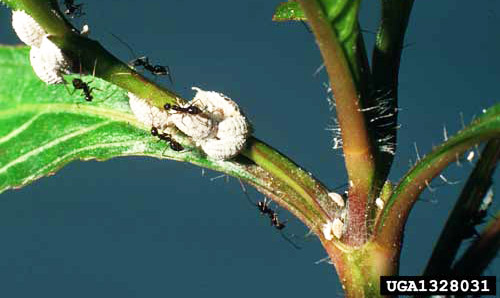
Workers are omnivorous, feeding on live and dead insects, seeds, honeydew, fruits, plant exudates, and many household foods. The crazy ant thrives in places such as gasoline stations, convenience stores, and sidewalk cafes where worker ants may be seen transporting crumbs and insects. They apparently have a seasonal preference for a high-protein diet, and during the summer months may refuse honey or sugar baits. They obtain honeydew by tending aphids, mealybugs, and soft scales (Smith 1965). Large prey items are carried by a highly concerted group action (Trager 1984).
Figure 9. Workers of the crazy ant, Paratrechina longicornis (Latreille), frequently tend mealybugs and related insects for the sugary honeydew produced by these insects. Photograph by Alton N. Sparks, Jr., University of Georgia, www.forestyimages.org.
The workers are known to gather small seeds of such crops as lettuce and tobacco from seedbeds. In cold climates, the ants nest in apartments and other buildings where they are potential pests year round.
Nest Sites (Back to Top)
The crazy ant is highly adaptable. The crazy ant often nests some distance away from its foraging area. It nests in such places as trash, refuse, cavities in plants and trees, rotten wood, and in soil (Smith 1965). These ants can nest in a variety of locations from dry to moist environments. A crazy ant nest site can be found by looking for workers carrying food back to the nest.
Management (Back to Top)
Non-chemical control is based on exclusion through eliminating food sources. Crazy ants nest outdoors so caulking exterior penetrations and weather-stripping may prevent their entrance. Indoor chemical controls are baits, dusts, and spot treatments with residual sprays. Outdoor treatments include chemical formulations as baits, granules, dusts, and sprays. Read and follow label instructions and precautions before using any insecticide.
Selected References (Back to Top)
- Creighton WS. 1950. The Ants of North America. Bulletin of the Museum of Comparative Zoology 104. 585 pp.
- Mallis A. 1997. Handbook of Pest Control. 7th Edition. Franzak & Foster Co. Cleveland. 1990. 1152 pp.
- Marlatt CL. 1930. House ants, kinds and methods of control. USDA Farmer's Bulletin 740. 12 pp.
- Smith MR. 1965. House-infesting ants of the eastern United States; their recognition, biology, and economic importance. USDA Technical Bulletin 1326. 105 pp.
- Trager JC. 1984. A revision of the genus Paratrechina (Hymenoptera: Formicidae) of the continental United States. Sociobiology 9: 51-162.
- Wetterer JK. 2008. Worldwide spread of the longhorn crazy ant, Paratrechina longicornis (Hymenoptera: Formicidea). Myrmecological News 11: 137-149.
- Wilson EO, Taylor RW. 1967. The ants of Polynesia (Hymenoptera: Formicidae). Pacific Insects Monograph 14. 109 pp.