common name: tarnished plant bug
scientific name: Lygus lineolaris (Palisot de Beauvois) (Insecta: Hemiptera: Miridae)
Introduction - Distribution - Description - Life History - Hosts - Damage - Survey and Detection - Management - Selected References
Introduction (Back to Top)
The tarnished plant bug, Lygus lineolaris (Palisot de Beauvois), attacks a wide variety of economically important herbaceous plants, vegetable crops, commercial flower plants, fruit trees, and nursery stock (Kelton 1975). In fact, over half of the cultivated plant species grown in the United States are listed as host plants for tarnished plant bugs (Capinera 2001).
Less well known, but of increasing importance, is that Lygus lineolaris feeds on conifer seedlings. Coniferous nursery stock in British Columbia, Oregon, Florida, Mississippi, Arkansas, and Oklahoma has been damaged by Lygus lineolaris (Schowalter et al. 1986, Shrimpton 1985, South 1986). Approximately 50% of the loblolly pine seedlings in one southern forest nursery was damaged by Lygus lineolaris (South 1986). In early 1989, the risk of feeding damage by Lygus lineolaris prompted several Florida forest nurseries to initiate preventive insecticide applications. In one nursery, by late May 1989, non-treated plots of bare-root pine averaged 18.5 live pine seedlings/square foot, of which 24% exhibited feeding damage by Lygus lineolaris, while in insecticide-treated plots a density of 24 live pine seedlings/square foot and 2% damage was observed. Pine seedlings in a nursery severely damaged by Lygus lineolaris usually do not survive the growing season.
Distribution (Back to Top)
Lygus lineolaris occurs in all Canadian provinces, the continental United States, and most of the states of Mexico (Kelton 1975, Young 1986).
Description (Back to Top)
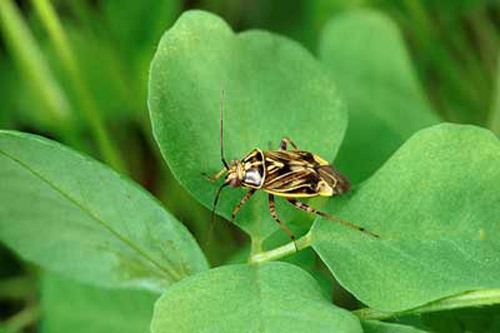
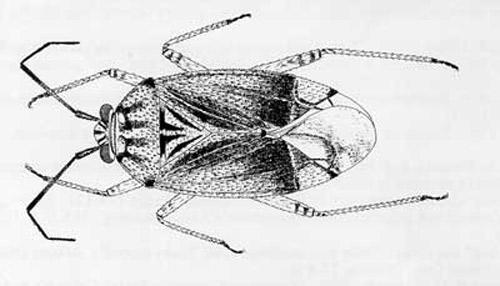
Adult: The adult male is 4.90 to 5.95 mm long, with a width of 2.38 to 3.01 mm; while the adult female is 5.25 to 5.95 mm long with a width of 2.52 to 3.01 mm. The head is yellowish-brown, with the frons smooth with black submedian lines. The rostrum is 2.17 to 2.52 mm long. The pronotum is yellowish to reddish brown, with the anterior angles rounded. The mesoscutum is black in color with the lateral areas pale or reddish. The hemelytra (anterior wings) are reddish brown, with a pubescence moderately long, dense and yellowish. The summer adult color varies from pale yellow with few black markings to reddish brown, or almost completely black with few pale yellow markings (Kelton 1975, 1980). The antennae and legs are relatively long. Overwintered adults are much darker than the summer adults (Capinera 2001).
Figure 1. Adult tarnished plant bug, Lygus lineolaris (Palisot de Beauvois). Photograph by Scott Bauer, USDA.
Figure 2. Adult tarnished plant bug, Lygus lineolaris (Palisot de Beauvois). Adapted from Kelton 1975. Drawing by Division of Plant Industry.
Egg: The egg is small, truncate and slightly curved. It is about 1 mm long and 0.25 mm wide. The top of the egg where it meets the surface of the plant tissue is flattened and has an opening through which the hatchling nymph emerges (Capinera 2001).
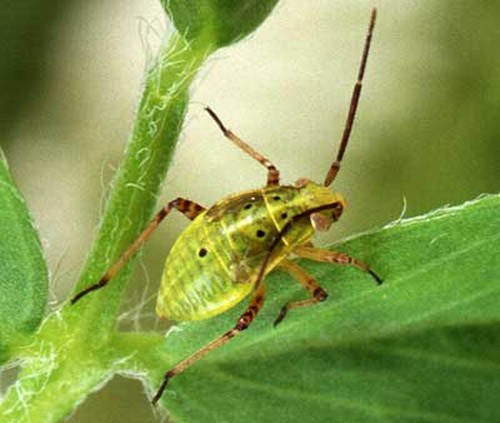
Nymph: Newly hatched nymphs are yellowish green and about 1 mm long. Older nymphs are yellow green to green and wingless. As they mature the nymphs develop yellow, green or black spots. Fourth and fifth stage nymphs have four black spots on the thorax and one on the abdomen. The head is light green. There are five nymphal instars. The full-grown nymph has wingpads and is about 4 to 4.5 mm long.
Figure 3. Fourth or fifth stage nymph of the tarnished plant bug, Lygus lineolaris (Palisot de Beauvois). Photograph by Scott Bauer, USDA.
Life History (Back to Top)
Overwintering as adults, Lygus lineolaris can be found in dead weeds, leaf litter, under tree bark, and in rock piles in fields, timber margins, stream and ditch banks, and road rights-of-way. Adults become active in early spring and feed on newly developing buds and shoots. Most nursery damage occurs from mid-April to late June (Cleveland 1982, Haseman 1918, Anonymous 1988).
Oviposition is apparently restricted to composite host plants (non-conifers). Eggs are often deposited in leaf petioles or at the base of the leaf blade, but the preferred location varies with the crop attacked (Capinera 2001). In conifers, eggs are inserted into flowerlets or blossoms. Eggs are usually deposited singly, but occasionally more than one egg will be found in an oviposition site (Capinera 2001). After seven to 10 days, ca. 1 mm long, yellowish-green nymphs emerge and begin feeding. There are five nymphal stages. The life cycle is completed in three to four weeks. There are two to three generations per year (Haseman 1918, Sutherland et al. 1989, Knight 1941, Ridgeway and Gyrisco 1960). Population peaks for adults generally occur in early July, early August, and early September (Rakickas and Watson 1974, Ridgeway and Gyrisco 1960).
Hosts (Back to Top)
At least 385 host plants have been recorded for Lygus lineolaris. A majority of the hosts are in the subclasses Rosidae and Asteridae. Principal economic hosts are apples, carrots, cherries, cotton, lima beans, seed alfalfa, snap beans, soybeans, peaches, pears, strawberries, tomatoes, and nursery stock (Haseman 1918, Tingey and Pillemer 1977, Young 1986).
Other vegetable crops subject to infestation are artichoke, asparagus, broccoli, cabbage, celery, chard, coriander, corn, cowpea, cucumber, eggplant, endive, escarole, fava bean, fennel, horseradish, lettuce, mustard, onion, parsnip, parsley, pea, pepper, potato, radish, spinach, squash, sweet potato, turnip and watermelon (Capinera 2001). Greenhouse hosts include asters, chrysanthemums, dahlias, impatiens, and marigolds.
As a conifer pest, Lygus lineolaris attacks loblolly pine Pinus taeda L. (South 1986); and severely damages Choctawhatchee sand pine [Pinus clausa (Chapm.) Vasey var. immuginata Ward] seedlings in southern forest nurseries.
Elsewhere, Lygus lineolaris damages white spruce, Picea glauca (Moench) Voss; lodgepole pine, Pinus contorta Dougl.; Douglas-fir, Pseudotsuga taxifolia (Poir.) Britt. (Shrimpton 1984); and larch, Larix occidentalis Nutt. (Sutherland et al. 1989).
Damage (Back to Top)
The tarnished plant bug is among the most damaging of the true bugs and is known to transmit plant diseases. The bugs use their needle-like mouthparts to extract plant juices. Their feeding causes terminal growth to be yellowed or distorted thereby reducing plant growth and causing them to appear unthrifty. Leaves from damaged buds are sometimes ragged and discolored. Flowers from damaged buds sometimes fail to develop on one side or the whole bud aborts
Survey and Detection (Back to Top)
Damage symptoms on most host plants attributed to Lygus bugs include leaf ragging, brown, discolored tissue, premature drop of buds, flowers, and fruit; cat-facing; increased number of vegetative branches; multiple crowns; elongation of internodes; split stem lesions; swollen nodes; and leaf crinkling (Tingey and Pillemer 1977). The appearance of plant parts damaged by Lygus lineolaris feeding has led to several color terms, e.g., "crazy cotton", "stop-back", "bush- head", "bushy-top."
Adults and nymphs of Lygus lineolaris feed by sucking plant juices and a watery saliva is simultaneously injected into the feeding site to aid in the breakdown of plant tissues. Symptoms appear within a few weeks after feeding injury. Generally, apical dominance is lost and weak multiple leaders appear. In conifer seedlings, terminal needles are thicker and shorter and the tip is often curled (Sutherland et al. 1989).
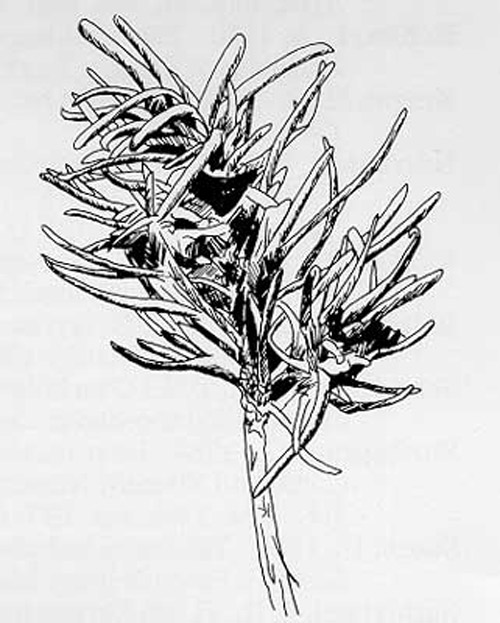
Figure 4. Typical appearance of conifer seedling damage by feeding of the tarnished plant bug, Lygus lineolaris (Palisot de Beauvois). Drawing by Division of Plant Industry.
Plant bug populations in crops tend to be aggregated or clumped. This necessitates large plant samples, if population assessments are to be accurate. White sticky traps at about 0.5 m are useful for detecting tarnished plant bugs in apple orchards and reportedly work well in vegetable crops (Capinera 2001).
Management (Back to Top)
The removal of preferred host plants from edges of nurseries and destruction of favorable overwintering sites will help to reduce the damages caused by Lygus lineolaris. Weed hosts include butterweed, fleabane, goldenrod, vetch, dock, and dog fennel.
Several insecticides are available to control populations of Lygus lineolaris. For management in crops search EDIS for recommendations by crop.
Several parasitoids are known, but the egg parasite Anaphis iole Girault, and the nymphal parasites Leiophron uniformis (Gahan), Peristenus pallipes (Curtis) and eristenus pseudopallipes (Loan) (all Hymenoptera) are thought to be relatively important. The native parasites seem to be more effective at parasitizing Lygus on weeds than on crops. The imported parasitoid Peristenus digoneutis Loan (Hymenoptera: Braconidae) is reported to have decreased tarnished plant bug abundance by 75% in New Jersey. In addition, it seems not to have affected native parasitoids (Capinera 2001).
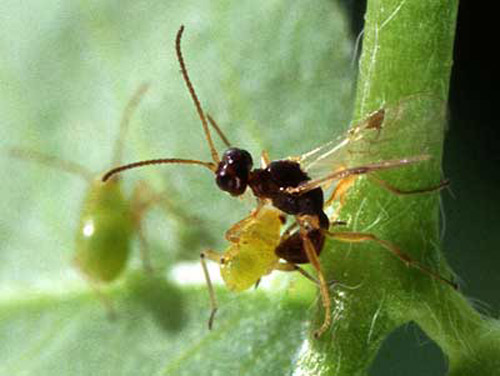
Figure 5. A quarter-inch-long parasitic wasp, Peristenus digoneutis Loan, prepares to lay an egg in a nymph of the tarnished plant bug, Lygus lineolaris (Palisot de Beauvois). Photograph by Scott Bauer, USDA.
Selected References (Back to Top)
- Anonymous. 1988. Lygus bug trapping results. Auburn University, Southern Forest Nursery Management Cooperative Newsletter. Spring 1988. 8 pp.
- Capinera JL. 2001. Handbook of Vegetable Pests. Academic Press, San Diego. 729 pp.
- Cleveland TC. 1982. Hibernation and host plant sequence studies of tarnished plant bugs, Lygus lineolaris, in the Mississippi delta. Environmental Entomology 11: 1049-1052.
- Haseman L. 1918. The tarnished plant-bug and its injury to nursery stock. University of Missouri, College of Agriculture, Agricultural Experiment Station Research Bulletin 29. 26 pp.
- Kelton LA. 1980. The Plant Bugs of the Prairie Provinces of Canada. Heteroptera: Miridae. The Insects and Arachnids of Canada. Part 8. Canadian Government Publishing Centre. Hull, Quebec. 408 pp.
- Knight HH. 1941. The plant bugs, or Miridae, of Illinois. Bull. Illinois Natural History Survey. 22: 1-234.
- Overhulser DL, Morgan PD, and Miller R. 1986. Control and impact of Lygus damage on 1-0 Douglas-fir seedlings. Pages 153-157. In: Proceedings of the Combined Western Forest Nursery Council and Intermountain Nursery Association Meeting. USDA Forest Service General Technical Report RM-137.
- Rikackas RJ, Watson TF. 1974. Population trends of Lygus spp. and selected predators in strip-cut alfalfa. Environmental Entomology 3: 781-784.
- Ridgeway RL, Gyrisco GG. 1960. Studies on the biology of the tarnished plant bug, Lygus lineolaris. Journal of Economic Entomology 53: 1063-1065.
- Schowalter TD, Overhulser DL, Kanaski A, Stein JD, Sexton J. 1986. Lygus hesperus as an agent of apical bud abortion in Douglas-fir nurseries in western Oregon. New Forests 1: 5-15.
- Shrimpton G. 1984. Four insect pests of conifer nurseries in British Columbia. Pages 119-121. In: Proceedings of the Combined Western Nursery Council and Intermountain Nurserymen's Association Meeting. U.S. Department of Agriculture Forest Service General Technical Report INT-185.
- South D. 1986. The "tarnished plant bug" can cause loblolly pine seedlings to be "bushy-topped." Auburn University Southern Forest Nursery Management Cooperative 27: 6.
- Sutherland JR, Shrimpton GM, Sturrock RN. 1989. Diseases and insects in British Columbia forest seedling nurseries. Canada-British Columbia Forest Resource Development Agreement Report 065: 85.
- Tingey WM, Pillemer EA. 1977. Lygus bugs: Crop resistance and physiological nature of feeding injury. Bulletin of the Entomological Society of America 23: 277-287.
- Young OP. 1986. Host plants of the tarnished plant bug, Lygus lineolaris (Heteroptera: Miridae). Annals of the Entomological Society of America 79: 747-762.