common name: lance nematode
scientific name: Hoplolaimus galeatus (Cobb, 1913) Thorne, 1935 (Nematoda: Secernentea:
Tylenchida: Tylenchoidea: Hoplolaimidae)
Introduction - Distribution - Importance - Symptoms - Hosts - Management - Selected References
Introduction (Back to Top)
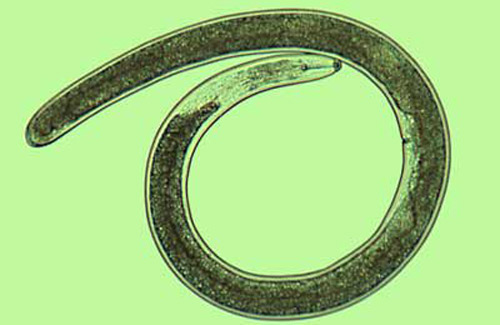
Among nematodes, which are often too small to be accurately detected by sight, the lance nematode Hoplolaimus galeatus (Cobb, 1913) Thorne, 1935, is one of the larger species. As adults they measure about 1.5 mm in length. Although other species of lance nematodes can be very damaging to agronomic crops, H. galeatus is known primarily as a pest of turfgrasses.
Figure 1. The adult lance nematode Hoplolaimus galeatus measures about 1.5 mm in length. Photograph by Jon Eisenback, Virginia Polytechnic Institute and State University.
Distribution (Back to Top)
In the U.S., H. galeatus can be found along the East Coast from New England to Florida and the Mississippi River basin from Minnesota and Wisconsin to Louisiana, as well as in Colorado, California and Texas. Internationally, it is found in Canada, Sumatra, India, Tanzania, and Central and South America.
Importance (Back to Top)
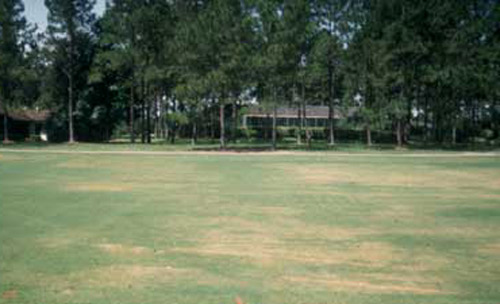
In Florida, lance nematodes are right behind sting nematodes as the worst nematode pests of turfgrass. They are very common in home lawns and are the major nematode pest of St. Augustinegrass in the Southeast. Lance nematodes are also an important pest on golf courses and are the most common nematodes causing damage on Bermudagrass putting greens in Florida. While it takes fewer sting nematodes to cause damage to turfgrasses, lance nematodes have a much larger distribution and are much more difficult to control with chemicals.
Symptoms (Back to Top)
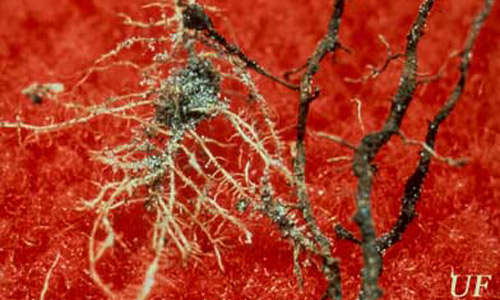
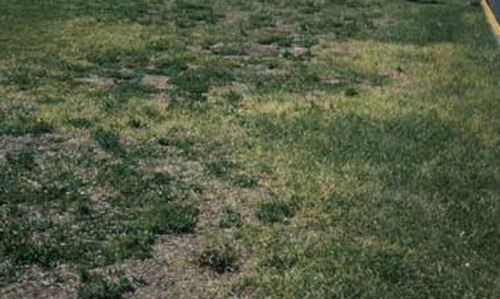
Damage may show up as patches of yellowing, dying or unthrifty grass, not unlike that caused by chinch bugs or some fungal pathogens. These symptoms also can be caused by drought or nutrient deficiency. Examination of the roots of a lance nematode-infested lawn often will reveal thorough damage to the root system. Small feeder roots are gone, and root tips appear dead. If new roots have begun to grow, they usually are injured as well. It is this damage to the root system that is responsible for the yellow or dying patches of grass.
Figure 2. Compared with the healthy St. Augustinegrass roots on the left, the lance nematode-damaged roots on the right appear dark and are missing small feeder roots. Photograph by R.A. Dunn, University of Florida.
Figure 3. Patches of yellowing, dying or unthrifty grass are often typical of lance nematode damage, seen here in St. Augustinegrass. Photograph by R.A. Dunn, University of Florida.
Figure 4. This Bermudagrass shows typical signs of damage from the lance nematode, the most common nematode pest on Bermudagrass putting greens in Florida. Photograph by R.A. Dunn, University of Florida.
Often when lance nematodes are present, other turf-damaging nematodes are present as well. Greenhouse and microplot tests have proven that H. galeatus is pathogenic to St. Augustinegrass and Bermudagrass, but it is difficult to pinpoint how much responsibility lance nematodes should bear for the damage when other nematodes are also present.
H. galeatus may attach itself to the roots by embedding its anterior end, or sometimes its entire body, inside. As it feeds, it destroys the root system, causing outer layers of the dead roots to slough away. This kind of damage is often a sign of lance nematode infestation but may also be caused by fungal root rot.
Nematodes may harm plants indirectly, as well. By feeding on the roots, the lance nematode opens wounds through which microorganisms in the soil can enter, causing the root to rot. These microorganisms are usually present in the soil, but it is not until the lance nematode provides easy entry to the root that they cause damage.
Hosts (Back to Top)
Lance nematodes parasitize a wide variety of hosts. Many trees, crops and grasses are subject to damage, including cotton, pine, oak, wheat, corn, beans, bananas, peas, cabbage, sweet potatoes, peanuts, chrysanthemums, sycamore, apple, clover, alfalfa and lawn grasses.
Management (Back to Top)
Chemical controls have proven relatively ineffective on lance nematodes, even when they do the job on other types of nematodes.
Careful turf management may help minimize the turf damage caused by lance nematodes. Deep watering, only as often as necessary, encourages the growth of deep roots more resistant to nematode damage. Balanced fertilizer applications are helpful, too, but too much nitrogen can cause roots to grow too rapidly and make them more susceptible to nematodes. Mowing at the recommended height, rather than too short, can prevent the problem of having insufficient foliage to provide food for the root system. In full sun, St. Augustinegrass generally does best at 2.5 inches high. A little more height is necessary in the shade. On golf course putting greens, raising mowing heights a couple of hundredths of an inch can increase nematode tolerance substantially. Shade and traffic cause additional stress to grasses.
For the most current recommendations for nematode management, see:
Nematode Management Guide for home lawns
Nematode Management Guide for golf courses in Florida
Selected References (Back to Top)
- Camarena JER. 1963. Pathogenic and biological aspects of sting and lance nematodes. Dissertation, University of Florida.
- Crow WT, Dunn RA. (2001). Nematode management for home lawns. EDIS. http://edis.ifas.ufl.edu/ng039 (31 July 2001).
- Crow WT. (2001). Nematode management for golf courses in Florida. EDIS. http://edis.ifas.ufl.edu/in124 (31 July 2001).
- Fortuner R. 1991. The Hoplolaiminae. W.R. Nickle ed., Manual of Agricultural Nematology. Marcel Dekker, Inc., N.Y. pp. 669-720.
- Giblin-Davis RM, Cisar JL, Bilz FG, Williams KE. 1991. Management practices affecting phytoparasitic nematodes in 'Tifgreen' Bermudagrass.
- Henn RA. 1987. Development of sampling strategies for management studies of Hoplolaimus galeatus on St. Augustinegrass (Stenotaphrum secundatum). Dissertation, University of Florida.
- MacGowan JB, Dunn RA. 1989. Hoplolaimus galeatus: lance nematode on St. Augustinegrass from Florida.. Florida Department of Agriculture, Division of Plant Industry. Nematology Circular 161. Gainesville, FL
- Orton Williams KJ. 1973. Hoplolaimus galeatus. C.I.H. Descriptions of Plant Parasitic Nematodes, Set 2, No. 24. Commonwealth Institute of Helminthology. Herts, England.
- Perry VG, Smart Jr GC. 1965. Turf nematode problems in Florida. Bulletin of the Florida Turfgrass Association 12: 4-6.