common name: snail-eating snails of Florida
scientific name: Gastropoda
Introduction - Euglandina rosea - Rumina decollata - Haplotrema concavum - Gulella bicolor - Varicella gracillima floridana - Selected References
Introduction (Back to Top)
In Florida, there are three native and two introduced species of snails, belonging to five different families, that are known to feed on other snails. In addition, several introduced species of the Subulinidae are considered carnivorous, but little is known of their biology and identification is difficult.
The best known of the Florida predatory snails is the rosy wolfsnail, Euglandina rosea (Férussac, 1821), which was exported to Hawaii and other areas (Mead 1961) in vain attempts to control the giant African snail, (Achatina fulica Bowdich, 1821). A Mediterranean snail, the decollate snail, Rumina decollata (Linnaeus, 1758), is much heralded today (Fisher et al. 1980) in California as an effective biological control agent of the brown garden snail, Cornu aspersum (Müller, 1774). Relatively little is known of the other three species of snail-eating snails, two of which are less than 10 mm long. All of these Florida predaceous snails are easy to identify and the following account summarizes what is known of their distributions, identification and habits.
Euglandina rosea (Férussac 1821), rosy wolfsnail (Family Spiraxidae)
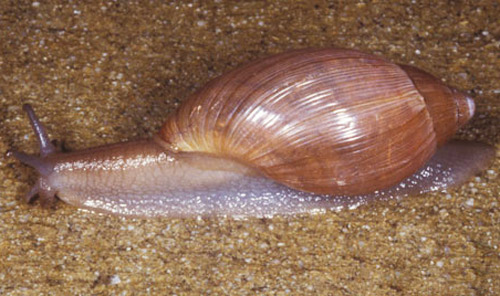
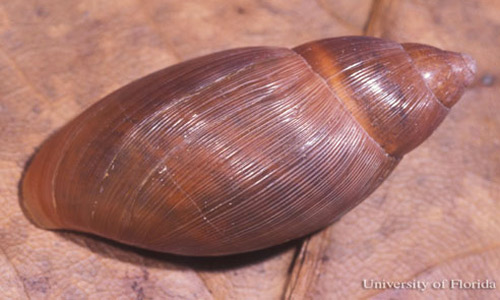
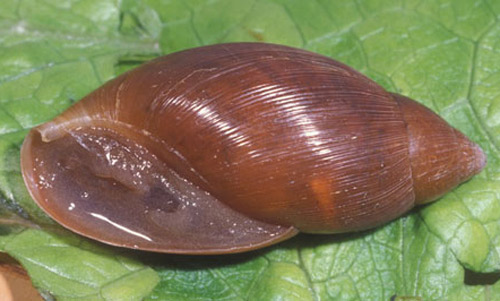
Identification: The shell is large, up to 76 mm in height and 27.5 mm in diameter, is thick and has prominent growth lines. The shape of the shell is fusiform with a narrow ovate-lunate aperture and a truncated columella. Typically, the shell color is brownish-pink. Adults measure 7-10 cm in length.
Figure 1. The rosy wolfsnail, Euglandina rosea (Férussac, 1821). Photograph by Lyle, J. Buss, University of Florida.
Figure 2. Top view of the rosy wolfsnail, Euglandina rosea (Férussac, 1821). Photograph by Paul M. Choate, University of Florida.
Figure 3. Reverse view of the rosy wolfsnail, Euglandina rosea (Férussac, 1821). Photograph by Paul M. Choate, University of Florida.
Distribution: In the United States: Alabama, Florida, Georgia, Hawaii, Louisiana, Mississippi, South Carolina and southeastern Texas. It is widespread in Florida, including the Keys. It is widespread, but usually found singly in hardwood forests, roadsides and urban gardens (Hubricht 1985).
Comments: This snail was chosen as a possible biological control agent of the giant African snail. Live specimens were sent to Hawaii in 1955 (Mead 1961). Although feeding in Achatina was observed, as well as on the Asian tramp snail, Bradybaena similaris (Férussac, 1821) and native tree snails (Hart 1978), no real control was achieved. The snail reproduced rapidly in Hawaii and, by 1958, 12,000 snails were harvested for release in other Hawaiian Islands, New Guinea, Okinawa, Palau Islands, Philippines and the Bonin Islands. Chiu and Chou (1962) gave details of the biology of Euglandina in Taiwan. Individuals live up to 24 months and adults lay 25 to 35 eggs in a shallow pocket in the soil. These hatch after 30 to 40 days. In Taiwan, Euglandina consumed as many as 350 Achatina during its lifetime. Euglandina rosea is now considered invasive in Hawaii as it has caused the extinction of eight native snail species.
Click here for a video of what happens when a rosy wolf snail and a cuban brown snail meet.
Click here for a video of what happens when a rosy wolf snail and a carolina mantle slug meet.
Rumina decollata (Linnaeus 1758), the decollate snail (Family Subulinidae) (Back to Top)
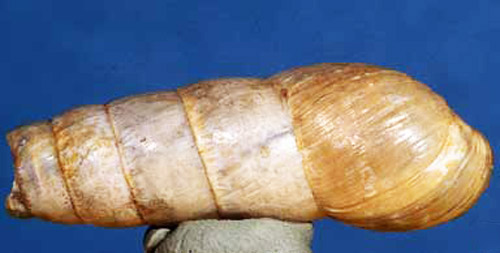
Identification: The adult shell is large, being up to 45 mm in height and 14 mm in diameter. It only retains four to seven whorls in adulthood, the other eight to 10 whorls being lost. The shell is perforate, glossy and sculptured with prominent axial growth lines and fine spiral striae. The columella is straight, its lip margin reflexed but the outer lip is simple. The shell color is pinkish brown. It is not easily confused with any other snail in Florida.
Figure 4. Top view of the decollate snail, Rumina decollata (Linnaeus, 1758). Photograph by Paul M. Choate, University of Florida.
Figure 5. Reverse view of the decollate snail, Rumina decollata (Linnaeus, 1758). Photograph by Paul M. Choate, University of Florida.
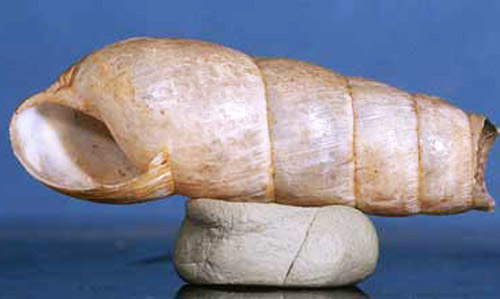
Distribution: Native to the Mediterranean area, but introduced widely in the United States, Bermuda and Mexico. It is widespread, but localized, in the Sun Belt from California east to Florida and north along the Atlantic coast to Pennsylvania. Very localized populations in Florida are known from Pensacola (Dundee 1970), Miami, Key Vaca and Marathon.
Comments: This snail was long considered a minor plant pest (Brantlinger 1953), although recognized as omnivorous. In California (Fisher et al. 1980), studies showed this snail is an effective predator of half-grown brown garden snails in particular and, like the brown garden snail, prospered only in cultivated habitats with frequent irrigation. It is thought that rodents limit the feral spread of the snails. Decollate snails will feed on new sprouts, old leaves, especially those in contact with the soil, and fallen bruised fruit. Their value in controlling the brown garden snail is considered to outweigh their minor pest attributes in California. These snails are ground dwellers, living among leaves, and sometimes burrowing in the upper one inch of soil (Fisher et al. 1980).
Haplotrema concavum (Say, 1821), gray lancetooth (Family Haplotrematidae) (Back to Top)
Identification: The shell is large, 10 to 22 mm in diameter and 5 to 10 mm in height, and depressed with 5 to 5 1/2 whorls. The whorls are convex with deeply impressed sutures. The umbilicus is broadly open, about 1/3 shell diameter. The shell is moderately strong, shining and smooth except for irregular axial striations and occasional fine spiral incised lines. The aperture is round to lunate. The parietal callus is yellowish, usually with a thickened edge. The shell color is white to very pale brown (dead) or greenish-white to light yellow (alive).
Figure 6. The gray lancetooth, Haplotrema concavum (Say, 1821). Photograph by Bill Frank, www.jaxshells.org.
Figure 7. The gray lancetooth, Haplotrema concavum (Say, 1821). Photograph by Bill Frank, www.jaxshells.org.
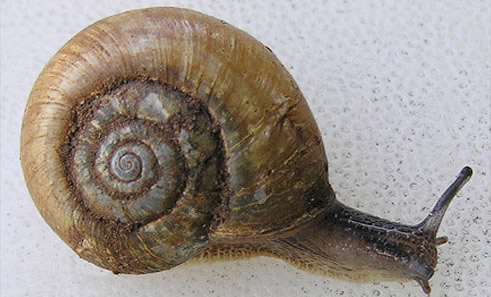
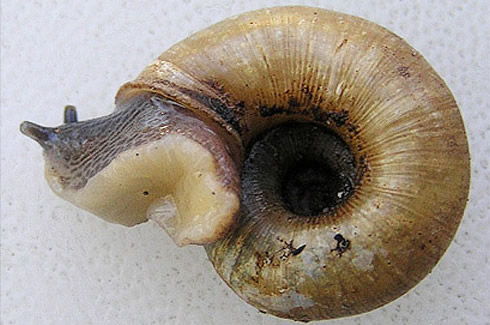
Distribution: Southern Canada to the Gulf States and west to eastern Nebraska and Oklahoma (Hubricht 1985). In Florida, it is presently known only from counties bordering the Apalachicola River.
Comments: Found in humid hardwood forests, living in leaf litter at tree bases, or under rotting logs. Pilsbry (1946) states that this family is rapacious, but Hubricht (1985) found this species feeding on dead shells more often than living snails, suggesting that this species may be using other snails as a source of lime rather than as prey. In Florida, these snails, especially juveniles, could be confused with the smaller, introduced species of Oxychilus. However, the much broader and open umbilicus of Haplotrema is distinctive.
Huttonella bicolor (Hutton, 1834), two-toned gulella (Family Streptaxidae) (Back to Top)
Identification: The shell is small, 5 to 7.5 mm in height and 1.5 to 2.0 mm in diameter), elongate and sturdy. Shell color is very pale brown to white; live specimens are bright orange due to body color. Shell sculpture is smooth, except at sutures where axial riblets are present. Well developed axial ribs are present behind apertural lip and in the umbilical region. Aperture with four prominent teeth.
Figure 8. The two-toned gulella, Huttonella bicolor (Hutton, 1834). Drawing by Bill Frank, www.jaxshells.org.
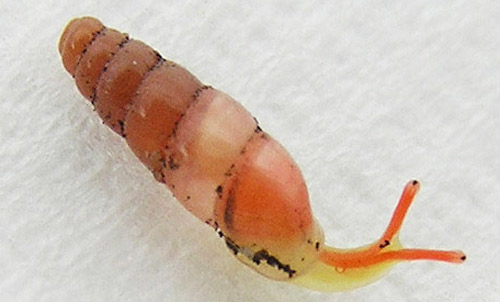
Distribution: Introduced from Orient (Burch 1962) or southern Africa (Dundee 1974). Widespread in the Caribbean region. In the United States, apart from Florida, it is also known from Louisiana, Mississippi, South Carolina, and Texas (Dundee 1974). It is also found in Brazil, Nicaragua, Australia (Northern Territory), and the Pacific area.
Comments: This snail is apparently an effective predator of Subulina octona (Bruguière, 1798) (Mead 1961) and pupillids (Dundee and Baerwald 1984). In Florida, the presence of four apertural teeth is diagnostic except for some tiny species of Pupillidae which are distinguished by their ovate or pupate shapes.
Varicella gracillima floridana Pilsbry, 1907, a predatory snail (Family Oleacinidae) (Back to Top)
Identification: The shell is small, 6 to 8 mm in height and 1.5 to 1.7 mm in diameter), elongate, somewhat scariform and thin. The whorls number 8 to 8 1/2, and are convex with deeply impressed sutures. Shell sculpture is distinctive with about 25 straight, narrow axial ribs, between which are six to eight fine axial striae. The shell is imperforate, the aperture ovate, and the outer lip slightly sigmoid, arching forward at middle but receding at base. The columella is straight and slightly calloused. Shell color is pale brown.
Figure 9. Varicella gracillima floridana Pilsbry 1907. Photograph by John Slapcinsky, University of Florida.
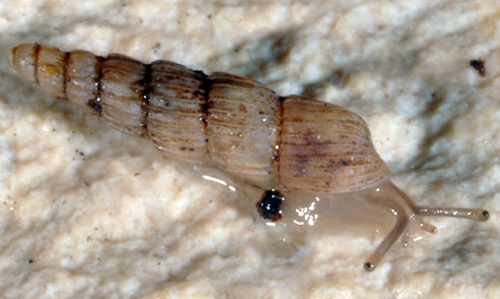
Distribution: Collected only from the Florida Keys and the Miami area. The subspecies Varicella g. gracillima (Pfeiffer 1851) occurs in Western Cuba (Pilsbry 1946).
Comments: These snails live under leaf litter, logs and rocks, usually in hardwood hammocks. No studies have been made of their biology, but Burch (1962) implied they are predatory on other snails.
Selected References (Back to Top)
- Brantlinger. 1953. A European Snail. Arizona Cooperative Economic Insect Report 3: 849.
- Burch JB. 1962. How to Know the Eastern Land Snails. Wm. C. Brown Co., Publishers, Dubuque, Iowa. 214 pp.
- Chiu Shui-Chen, Ken-Ching Chou. 1962. Observations on the biology of the carnivorous snail, Euglandina rosea Ferussac. Bulletin Institute of Zoology, Academia Sinica 1: 17-24.
- Dundee DS. 1970. Introduced Gulf Coast Mollusca. Tulane Studies in Zoology and Botany 16: 101-115.
- Dundee DS. 1974. Catalog of introduced molluscs of eastern North America (North of Mexico). Sterkiana 55: 1-37.
- Dundee DS, Baerwald RJ. 1984. Observations on a micropredator Gulella bicolor (Hutton) (Gastropoda: Pulmonata: Streptaxidae). Nautilus 98: 63-68.
- Fisher TW, Orth RE, Swanson SC. 1980. Snail against snail. California Agriculture (Nov.-Dec.): 3 pp.
- Hart AD. 1978. The onslaught against Hawaii's tree snails. Natural History Magazine (December): 46-56.
- Hubricht L. 1985. The distributions of the native land mollusks of the eastern United States. Fieldiana, Zoology (new series) No. 24: i-viii, 1-191.
- Mead AR. 1961. The Giant African Snail; a Problem in Economic Malacology. University of Chicago Press, 257 pp.
- Pilsbry HA. 1946. Land Mollusca of North America (North of Mexico). Academy of Natural Sciences Philadelphia Monographs No. 3, 2:1-520.