common name: tree squirrel bot fly
scientific name: Cuterebra emasculator Fitch (Insecta: Diptera: Oestridae)
Introduction - Distribution - Description and Life Cycle - Hosts - Host Impact and Treatment - Relationship to Humans - Selected References
Introduction (Back to Top)
The tree squirrel bot fly, Cuterebra emasculator Fitch, is an obligate parasite of tree squirrels and chipmunks throughout most of eastern North America. The adult and other life stages are seldom seen; instead, what is usually observed from July through September or October is the outcome of infestation, namely the relatively large, fluid-draining swellings (‘warbles') in a host's hide caused by the subcutaneous larvae.
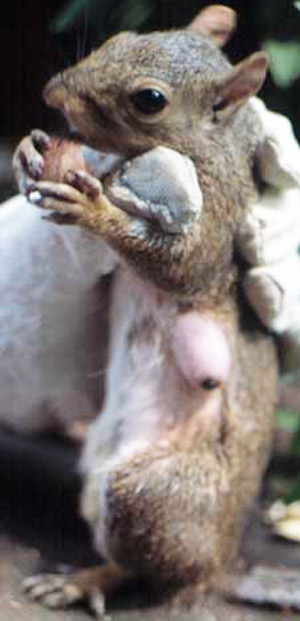
Figure 1. Eastern gray squirrel with a warble of a 3-week-old, tree squirrel bot fly, Cuterebra emasculator Fitch, on its side. Photograph by Frank Slansky and Lou Rea Kenyon.
Bot fly infestation may be mistaken for another lump-causing affliction of tree squirrels, namely a viral disease called 'squirrel pox' or 'fibromatosis'. The latter generally is distinguishable from bot fly infestation based on the presence of a higher number of smaller lesions (especially around the eyes), swollen digits of the infested animal, and the lack of a distinct, fluid-draining opening in each lesion.
The tree squirrel bot fly is one of some 30 species of Cuterebra native to the Americas, five of which are found in Florida. Cuterebra larvae parasitize either native rodents (mice, rats, tree squirrels, etc.) or lagomorphs (rabbits and hares); those species utilizing the former as hosts do not naturally infest the latter, and vice versa. This species was named Cuterebra emasculator some 150 years ago by one of the most prominent entomolgists of that period, Asa Fitch, based on the erroneous belief that the larvae consumed the testes of male hosts.
Distribution (Back to Top)
The tree squirrel bot fly has been reported from some 20 states in the U.S. and two Canadian provinces throughout eastern North America (east of the Mississippi River).
Within Florida, it is found throughout the northern and central parts of the state (including the Panhandle) but is rare in or absent from more southern counties, despite the presence of tree squirrels in these areas.
Description and Life Cycle (Back to Top)
Tree squirrel bot flies undergo complete metamorphosis, which consists of an egg, larva, pupa and adult. This species is univoltine, having one generation per year throughout its range. The pupal stage overwinters buried in soil and requires about eight to 10 months before emerging as an adult.
Adults: Tree squirrel bot fly adults are black with a pale yellow thorax and smokey-black wings. They are relatively large flies with broad bodies, reaching a length of about 16 to 20 mm, and generally resemble bumblebees, but they do not visit flowers for nectar or pollen or consume other food, bite or sting.
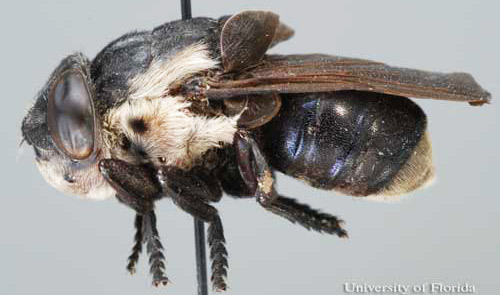
Figure 2. Adult bot fly Cuterebra fontinella Clark. This species typically infests wild mice (Peromyscus spp.). Photograph by Lyle Buss, University of Florida.
An adult fly emerges by breaking a line of weakness in its puparium using a hemolymph-inflated, balloon-like structure (ptilinum) on its head. After this one-time use, the ptilinum is withdrawn into the head and the slit (suture) in the fly's head permanently seals shut.
Tree squirrel bot fly adults appear in early summer and seek a mate. Whether the males congregate at some distinctive physical feature in the habitat and await females of their species for mating, a behavior described for some western Cuterebra species, is unknown. Female Cuterebra emasculator presumably lay their eggs on natural substrates such as twigs, branches and vegetation in the habitat of their hosts, as documented for certain other Cuterebra species, rather than directly on their hosts, as do some species of parasitic flies, such as horse stomach bot flies (Gasterophilus spp.) and blow flies (e.g., Calliphora, Lucilia and Phormia spp.). Cuterebra spp. bot flies have relatively high fecundity, exceeding 1,000 eggs per female.
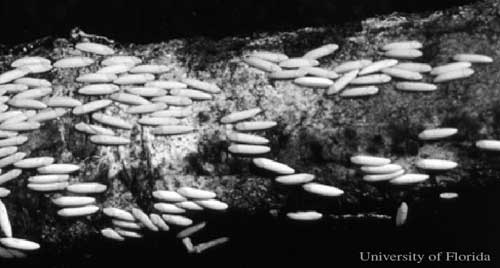
Eggs: Tree squirrel bot fly eggs are off-white and oblong, about 1.5 mm long, and resemble tiny grains of rice. Larvae develop to the first instar but remain within the egg until body heat or carbon dioxide from a potential host stimulates them to rapidly emerge through a 'trap door' (operculum) at one end of the egg shell (chorion).
Figure 3. Eggs of a bot fly, Cuterebra sp. Photograph by Paul M. Choate, University of Florida.
Larvae: The legless larvae of flies generally are called 'maggots', and the larvae of bot flies are often referred to as 'bots'. First instars of Cuterebra emasculator comprise the infective stage; they are whitish and encircled by several bands of black spines. Upon emerging from an egg, a larva may attach to its substrate with a specialized pad-like structure and sway back and forth in a questing behavior. If a first instar contacts a potential host and is able to transfer to it, the larva may enter an orifice (mouth, nostrils, anus) or wound and begin a journey through the host's body that lasts about a week. It then settles underneath the host's hide, molts to the second instar, and creates a hole to the exterior. This 'warble pore' provides access to air for breathing and a route for elimination of liquid excrement. The presence of the larva stimulates a reaction by surrounding host tissues, which form a pocket or 'warble' that encapsulates the larva.
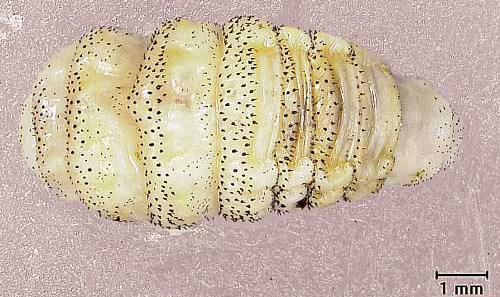
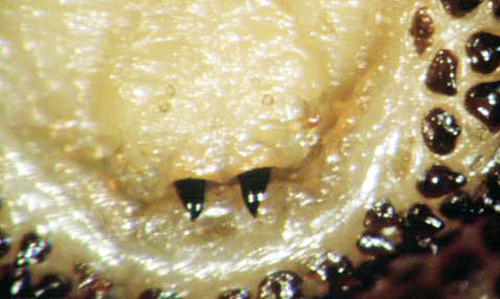
After a week or so, the cream-colored second instar, which is encircled with bands of black spines like the previous instar, molts to a third instar. The third (final) instar has two prominent black mouth hooks and is covered with ovate to fish scale-like cuticular platelets. Initially, these are cream colored and then they pass through darkening shades of tan, as they become sclerotized, eventually becoming dark brown.
Figure 4. Second instar larva of the tree squirrel bot fly, Cuterebra emasculator Fitch, from an eastern gray squirrel (dorsal view, anterior end to left). Photograph by Craig Welch, University of Florida.
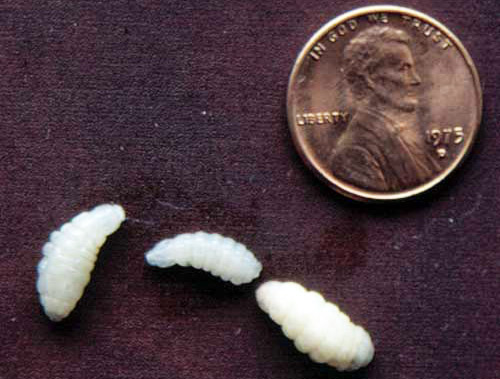
Figure 5. Second instar larvae of the tree squirrel bot fly, Cuterebra emasculator Fitch, collected from an eastern gray squirrel. Photograph by Frank Slansky and Lou Rea Kenyon.
Figure 6. Second instar larva of the tree squirrel bot fly, Cuterebra emasculator Fitch, from an eastern gray squirrel, showing head region with mouthhooks. Photograph by Frank Slansky.
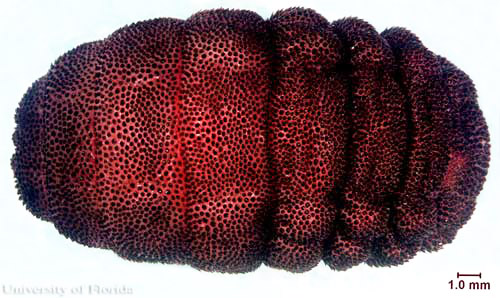
Figure 7. Third instar larva of the tree squirrel bot fly, Cuterebra emasculator Fitch, from an eastern chipmunk (dorsal view, anterior end to left). Photograph by Craig Welch, University of Florida.
Figure 8. Third instar larva of the tree squirrel bot fly, Cuterebra emasculator Fitch, from one eastern gray squirrel, showing head region with mouthhooks. Photograph by Frank Slansky.
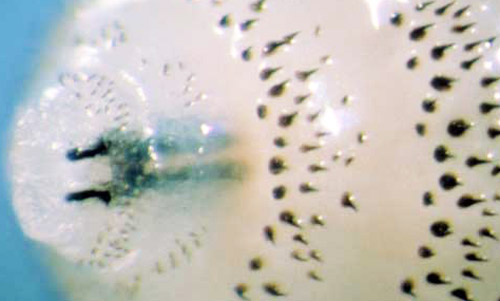
Typically, only one larva occurs in each warble. The bot fly larva orients with its head (anterior) end situated toward the inside of the host, and its anal (posterior) end, which contains the two kidney-shaped respiratory spiracles, at the warble pore. Unlike many other arthropod parasites of vertebrates, Cuterebra spp. larvae presumably do not ingest blood but instead consume lymph fluid and possibly cellular debris and leukocytes of the host. Total larval development of the tree squirrel bot fly lasts three to four weeks, after which the mature larva emerges from the host by backing out through the warble pore, dropping to the ground, and burrowing into the soil where it pupates.
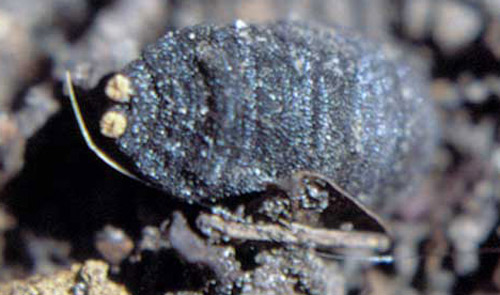
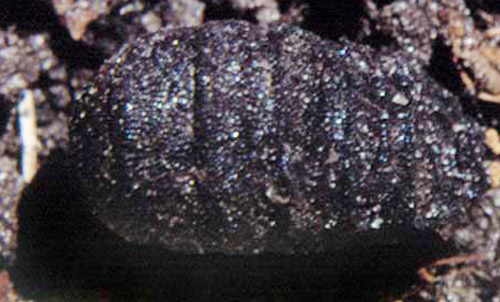
Pupae: The pupal stage consists of a dark chocolate brown, hardened puparium enclosing the pupa that develops into the adult fly after passing through the autumn, winter and spring in the soil in a physiologically quiescent state termed 'diapause'. Two pale yellow, flower-like anterior spiracles are everted during formation of the puparium.
Figure 9. Puparium of the tree squirrel bot fly, Cuterebra emasculator Fitch, produced by a larva from an eastern gray squirrel. Note the two, light-colored, button-like anterior spiracles (at left) everted during pupariation. Photograph by Frank Slansky.
Figure 10. Puparium of the tree squirrel bot fly, Cuterebra emasculator Fitch, next to a ruler. Photograph by Frank Slansky.
Hosts (Back to Top)
Commonly reported natural hosts for Cuterebra emasculator include eastern gray squirrels (Sciurus carolinensis), fox squirrels (Sciurus niger) and eastern chipmunks (Tamias striatus). American red squirrels (Tamiasciurus hudsonicus) and flying squirrels (Glaucomys spp.) are rarely reported as hosts.
Larvae of bot flies also occasionally infest atypical hosts such as raccoons, cats, dogs and humans, an affliction termed 'cuterebrosis' or 'cuterebriasis', but which species of Cuterebra are responsible in these cases has seldom been determined. Currently, there is no evidence that Cuterebra emasculator is involved in such situations.
Host Impact and Treatment (Back to Top)
Cuterebra spp. larvae are obligate parasites, requiring a living mammalian host for survival. Consequently, if they kill their host before they are fully developed, they will also perish. Thus there should be strong selective pressure to minimize their deleterious impacts on hosts. A variety of physiological effects on a host may result from infestation by Cuterebra spp. larvae, including anemia and changes in the size of certain organs and glands. These effects generally do not cause the death of individual hosts and they seem to have little negative impact on the dynamics of a host population.
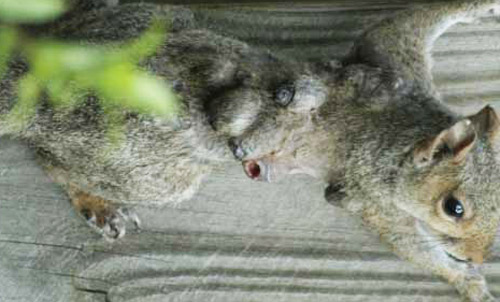
Figure 11. Eastern gray squirrel with warbles of the tree squirrel bot fly, Cuterebra emasculator Fitch. Photograph by Martha Ivey.
Gray squirrels are often infested by one or a few larvae. The large, fluid-draining warbles are often surrounded by patches of bare skin, and appear rather gross. However, an otherwise healthy adult host with access to adequate food and water probably can tolerate at least four to five of these insects with little obvious effect on its behavior other than stimulating efforts to scratch the warbles. But, at higher infestation levels (squirrels with 10 or more larvae have been observed) and in situations where there is a scarcity of food or water, or if the host is an infant, pregnant or nursing infants, these parasites can be harmful. For example, a heavily infested squirrel may become weakened and more vulnerable to predation, a fatal bacterial infection may set in, or a mother squirrel may experience a diminished milk supply leading to the death of her nursing offspring. With gray squirrels, the larvae often are found in the upper torso, although they may occur on the head, limbs and most other areas of the body except the tail.
Especially with chipmunks, in which the larvae of Cuterebra emasculator often settle in the lower abdomen, a male host's testes may be temporarily prevented from descending into the scrotum or displaced back into the abdomen by the presence of a larva, and this might lead to short-term effects on reproduction, but this hypothesis requires experimental testing. Nonetheless, it is clear that these larvae, contrary to what was originally believed when this species was first given its scientific name, do not consume a host's testes.
Because tree squirrel bot flies are natural, native parasites of squirrels and chipmunks, control efforts are not initiated; there is no known method for preventing infestation by these larvae. However, if an injured or orphaned animal that is also infested with larvae of Cuterebra emasculator requires care from a wildlife rehabilitator or veterinarian, the larvae often are removed. Forceps are used to grab the posterior end of a larva through the warble pore, and it is gently pulled out. The empty warble may be flushed with an antiseptic, followed by application of antibiotics. Sufficient studies have not been performed with anti-parasitic drugs to recommend their use in controlling Cuterebra spp. infestations.
Empty warbles typically heal within a week or so after a larva has exited its warble naturally or has been removed. It is unclear whether previously infested hosts develop resistance to subsequent infestation by larvae of Cuterebra emasculator, but the presence of second and third instars within an individual host suggests that multiple infestations can occur.
Relationship to Humans (Back to Top)
As with other Cuterebra species, Cuterebra emasculator has little or no direct impact on humans, but this species does have some indirect influences. Many people observe tree squirrels, such as when these animals visit bird feeders or are purposely provided with food. In such situations, concerns are often raised over the presence of squirrels with large 'tumors.' Frequently asked questions by members of the public include "What is wrong with these squirrels?", "Can this problem spread to my family or my pets?" and "What can be done to help the affected squirrels and protect other squirrels from this problem?"
In answer to the latter question, as already mentioned, Cuterebra emasculator larvae are natural parasites of these rodents and, as such, control efforts are not applied, and in fact there are no known treatments available to prevent infestation of the natural hosts. Regarding the second question listed above, concerns about infested squirrels spreading this affliction to other squirrels, other animals or humans are unfounded. That is, once a larva becomes encapsulated under the hide of a host, it remains at that site until fully developed - only the tiny first instar is infective. Possibly, a dog, cat or other pet that has been outdoors might have infective-stage larvae crawling on its fur that could transfer to and infest a person coming in contact with the animal. Similarly, a mother squirrel returning to her nest after a bout of foraging might bring back infective-stage larvae on her fur that could transfer to and infest her young in the nest. Such modes of infestation have not been definitively documented, but they are remote possibilities. However, as previously mentioned, there is no evidence that larvae of Cuterebra emasculator have been responsible for any cases of cuterebrosis in domestic animals or humans.
Another indirect influence of Cuterebra emasculator on people involves the timing of squirrel hunting season. Concerns by natural resource officials in some states that many bagged squirrels were being discarded by hunters because of the presence of warbles of Cuterebra emasculator even though the meat of these squirrels was acceptable for human consumption have led to the establishment of squirrel hunting seasons that begin after the main period of squirrel infestation by these insects has ended.
Selected References (Back to Top)
- Baird JK, Baird CR, Sabrosky CW. 1989. North American cuterebrid myiasis. Journal of the American Academy of Dermatology 21: 763-772.
- Bennett GF. 1955. Studies on Cuterebra emasculator Fitch 1856 (Diptera: Cuterbridae) and a discussion of the status of the genus Cephenemyia. Letter, 1818. Canadian Journal of Zoology 33: 75-98.
- Bennett GF. 1973. Some effects of Cuterebra emasculator Fitch (Diptera: Cuterebridae) on the blood and activity of its host, the eastern chipmunk. Journal of Wildlife Diseases 9: 85-93.
- Catts EP. 1982. Biology of New World bot flies: Cuterebridae. Annual Review of Entomology 27: 313-338.
- Catts EP, Mullen GP. 2002. Myiasis (Muscoidea, Oestroidea), pp. 317-48 In Medical and Veterinary Entomology. Mullen G, Durden L (editors). Academic Press, San Diego, USA. 597 pp.
- Colwell DD. 2001. Bot flies and warble flies (order Diptera: family Oestridae), pp. 46-71 In Parasitic Diseases of Wild Mammals. Samuel WM, Pybus MJ, Kocan AA. (editors). Iowa State University Press, Ames.
- Cramer MJ, Cameron GN. 2006. Effects of bot fly (Cuterebra fontinella) parasitism on a population of white-footed mice (Peromyscus leucopus). Journal of Mammalogy 87: 1103-l111.
- Fitch A. 1856. Emasculating bot fly, Cuterebra emasculator, new species (Diptera: Oestridae), pp. 478-485 In Third Report on the Noxious and Other Insects of the State of New York, Fitch A. (editor). State Agricultural Society, Supplement, Albany, USA.
- Gingrich RE. 1981. Migratory kinetics of Cuterebra fontinella (Diptera: Cuterebridae) in the white-footed mouse, Peromyscus leucopus. Journal of Parasitology 67: 398-402.
- Glass EN, Cornetta AM, Delahunta A, Center SA, Kent M. 1998. Clinical and clinicopathologic features in 11 cats with Cuterebra larvae myiasis of the central nervous system. Journal of Veterinary Internal Medicine 12: 365-368.
- Jacobson HA, Guynn DC, Hackett EJ. 1979. Impact of the botfly on squirrel hunting in Mississippi. Wildlife Society Bulletin 7: 46-48.
- McKinney TD, Christian JJ. 1970. Incidence and effects of botfly parasitism in the eastern chipmunk. Journal of Wildlife Diseases 6: 140-143.
- Merck. 2006. Cuterebra infestation in small mammals: Introduction. Merck Veterinary Manual. (12 April 2016)
- Munger JC, Karasov WH. 1994. Costs of bot fly infection in white-footed mice: Energy and mass flow. Canadian Journal of Zoology 72: 166-173.
- Sabrosky CW. 1986. North American Species of Cuterebra, the Rabbit and Rodent Bot Flies (Diptera: Cuterebridae). Entomological Society of America Thomas Say Foundation Monographs, College Park, MD. 240 pp.
- Slansky F. 2006. Cuterebra bot flies (Diptera: Oestridae) and their indigenous hosts and potential hosts in Florida. Florida Entomologist 89: 152-160.
- Slansky F. 2007a. Insect/mammal associations: Effects of cuterebrid bot fly parasites on their hosts. Annual Review of Entomology 52: 17-36.
- Slansky F. 2007b. Feline cuterebrosis caused by a lagomorph-infesting Cuterebra spp. larva. Journal of Parasitology 93: 959-961.
- Slansky F, Huckabee J. 2006. First records of rodent-infesting Cuterebra bot flies parasitizing raccoons (Procyon lotor) in North America. Journal of Parasitology 92: 1369-1373.
- Slansky F, Kenyon LR. 2001a. Warbles of the tree squirrel bot fly. The Tree Squirrel Bot Fly. (no longer available online).
- Slansky F, Kenyon LR. 2001b. Squirrel fibromatosis: Comparisons & contrasts with bot fly infestation. The Tree Squirrel Bot Fly. (no longer available online).
- Slansky F, Kenyon LR. 2002. Bot fly (Diptera: Cuterebridae) infestation of nest-bound infant eastern gray squirrels. Florida Entomologist 85: 369-371.
- Slansky F, Kenyon LR. 2003. Cuterebra bot fly infestation of rodents and lagomorphs. Journal of Wildlife Rehabilitation 26: 7-16.
- Timm RM, Lee Jr, RE. 1981. Do bot flies, Cuterebra (Diptera: Cuterebridae), emasculate their hosts? Journal of Medical Entomology 18: 333-336.
- Wood DM. 1987. Oestridae, pp. 1147-1158 in Manual of Nearctic Diptera ,Vol. 2, McAlpine JF. (editor). Agriculture Canada, Ottawa, Canada.