common name: blueberry gall midge
scientific name: Dasineura oxycoccana (Johnson) (Insecta: Diptera: Cecidomyiidae)
Introduction - Distribution - Description - Life History - Plant Damage - Varietal Resistance - Management - Selected References
Introduction (Back to Top)
A gall midge, Dasineura oxycoccana (Johnson) (Diptera: Cecidomyiidae), is a recently discovered pest of rabbiteye blueberries (Vaccinium ashei Reade) in the southeastern US (Lyrene and Payne 1992). Midge larvae feed inside and destroy flower buds resulting in low yields. Midges also cause severe damage to vegetative growth. Plants cannot produce enough foliage to support a heavy fruit crop, resulting in smaller berries with low sugar. Some blueberry varieties have suffered a 100% crop loss due to depredations of this midge. The problem is most pronounced in southern portions of the rabbiteye blueberry production range where winter temperatures favor emergence of adult midges and larval development during critical stages of blueberry flower development. South of Gainesville, Florida, commercial rabbiteye blueberry production is not feasible if midges are left uncontrolled.
Distribution (Back to Top)
Dasineura oxycoccana is known from the northern United States (Maine, New Jersey, Michigan, Wisconsin, Washington) where it infests vegetative buds of blueberry and cranberry (Vaccinium macrocarpon Aiton). In southeastern Georgia, southern Mississippi, and Florida, midge populations attack both flower and vegetative buds of blueberry. Florida county records include (from north to south) Okaloosa, Washington, Alachua, Putnam, Marion, Citrus, and Hillsborough counties.
Description (Back to Top)
Adults are tiny, fragile flies approximately 2 to 3 mm long. Mature larvae are about 1 mm long and 0.3 mm wide, legless, and yellow to red in color. Gagné (1989) provides excellent details on larval and adult gall midge morphology.
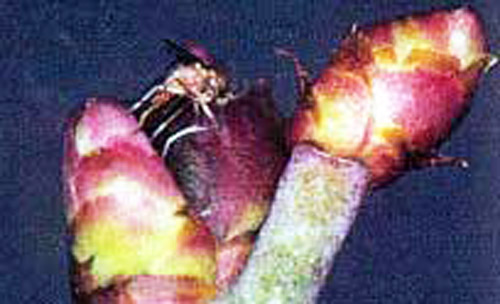
Figure 1. Adult blueberry gall midge, Dasineura oxycoccana (Johnson), ovipositing between bud scales of rabbiteye blueberry. Photograph by Division of Plant Industry.
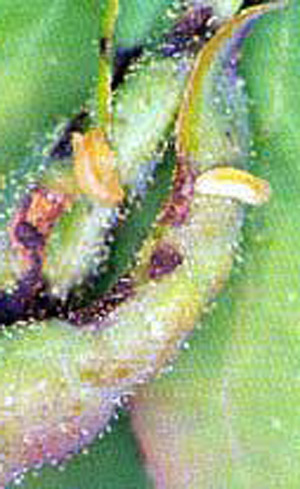
Figure 2. Larvae of the blueberry gall midge, Dasineura oxycoccana (Johnson), and leaf curling of rabbiteye blueberry. Photograph by Division of Plant Industry.
Life History (Back to Top)
The biology of the blueberry midge is still poorly known in the southeastern US. In North Florida, midges apparently produce five or six generations between early January and early June. The adult stage (during which mating and egg-laying take place) probably lasts only from one to a few days. Eggs are oviposited between the scales of flower buds after the buds begin to expand. Totally dormant buds are not infested. Eggs hatch in two to three days. Since larvae digest plant tissues, they are the plant-damaging stage. There may be from one to nine larvae in a single flower bud. Larvae apparently feed on bud tissues and on the pedicels that hold the individual flower buds to the peduncle within the developing flower cluster. Larvae probably drop to the ground after feeding, then pupate and transform to the adult stage. Under laboratory conditions, infested flower buds yielded adults after 12 days. Flower buds are subject to continuous oviposition from January to March. As plants progress to vegetative budding, oviposition also occurs on the new shoot meristems. Infested vegetative buds swell and the outer leaves curl enfolding feeding larvae inside. Oviposition continues until the end of May. During summer, fall, and early winter in Florida, larvae apparently enter developmental diapause and remain in the soil.
Plant Damage (Back to Top)
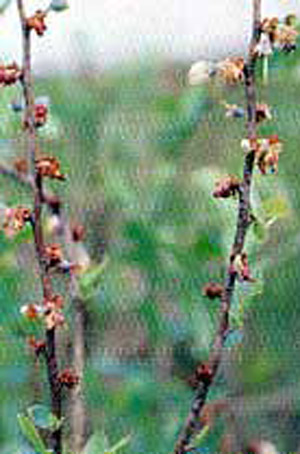
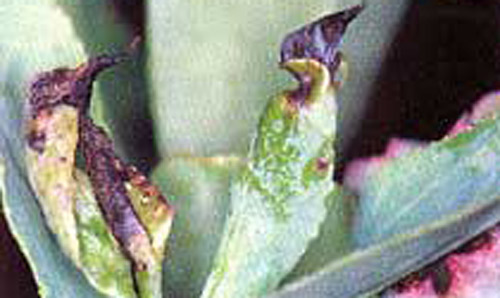
Flower buds dry up and disintegrate within about two weeks after infestation. High levels of flower bud abortion may occur during winter and early spring. The severity of damage varies from year to year and tends to be worse after mild winters and in more southern locations. Vegetative meristems may also be infested and killed or damaged leaving only very short shoots with a few highly distorted leaves. After mid-May, little damage occurs in Florida even though new growth flushes continue throughout the summer. The severity of damage also varies from field to field. Young plantings in their 2nd or 3rd year often flower and fruit well, even while nearby fields of mature plantings have severe bud loss. This suggests a low vagility (dispersion ability) of the midges and a slow population increase to pest proportions.
Figure 3. Aborted rabbiteye blueberry blooms due to infestation of the blueberry gall midge, Dasineura oxycoccana (Johnson). Photograph by Division of Plant Industry.
Figure 4. Meristem damage on rabbiteye blueberry due to infestation of the blueberry gall midge, Dasineura oxycoccana (Johnson). Photograph by J.A. Payne, USDA.
Varietal Resistance (Back to Top)
Rabbiteye blueberry cultivars vary greatly in their resistance to blueberry gall midge infestation. 'Powderblue' and 'Brightwell' are highly resistant to flower bud damage; 'Climax', 'Aliceblue', 'Beckyblue', 'Bonita', 'Tifblue' and 'Woodard' are moderately susceptible; and 'Premier' and 'Windy' are highly susceptible. Most southern highbush blueberry (Vaccinium corymbosum L.) cultivars are highly resistant to flower bud damage.
Vegetative meristem resistance is not necessarily associated with flower bud resistance, and there is wide variation in resistance among cultivars. Among rabbiteyes, 'Climax' is one of the most susceptible to meristem damage, and plants may remain almost leafless until late spring in years with high midge pressure. Despite their good flower bud resistance, highbush cultivars do suffer considerable meristem loss, although most cultivars are still able to foliate well.
Management (Back to Top)
Control methods are still under investigation (Lyrene and Payne 1995). Adults are readily killed with insecticides. However, their multivoltine life history and short adult lifespan necessitate careful scouting and timing of insecticide application. Contact your county Cooperative Service Extension agent or office for latest applicable insecticides. Egg and feeding larval stages are less easily killed, since these stages are at least partially protected by surrounding plant tissue. Larvae and pupae in the soil may be susceptible to a soil drench insecticide treatment. Any insecticide treatment during the blueberry flowering period must be judiciously applied because insect pollinators are active at this time. Alternatively, insecticides could be applied after flowering when vegetative meristems are under attack and huge midge populations are developing. This timing would reduce the oversummering larva population and subsequent midge attack the following winter and spring.
Cultural controls may be effective. Shallow disking beneath blueberries, probably in late fall or early winter, may kill diapausing larvae in the soil or expose them to predators. Likewise, using a disk to spread a thin layer of sand under the blueberry bushes may inhibit adults from emerging from the buried pupae.
Selected References (Back to Top)
- Gagné RJ. 1989. The Plant-feeding Gall Midges of North America. Cornell University Press, Ithaca, NY. 356 pp.
- Lyrene PM, Payne JA. 1992. Blueberry gall midge; a pest on rabbiteye blueberry in Florida. Proceedings, Florida State Horticulture Society 105: 297-300.
- Lyrene PM, Payne JA. 1995. Blueberry gall midge: a new pest of rabbiteye blueberries. Journal of Small Fruit Production.