common name: spined soldier bug
scientific name: Podisus maculiventris (Say) (Insecta: Hemiptera: Pentatomidae)
Introduction - Distribution - Description - Life Cycle - Economic Importance - Selected References
Introduction (Back to Top)
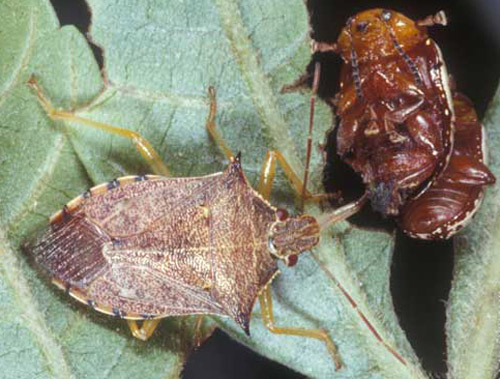
The spined soldier bug, Podisus maculiventris (Say), is a medium-sized predatory stink bug which preys on a wide variety of other arthropods, especially larval forms of Lepidoptera and Coleoptera (Mukerji and LeRoux 1965). The adult has a prominent spine on each "shoulder."
Figure 1. Dorsal view of an adult spined soldier bug, Podisus maculiventris (Say), feeding on a mating pair of sumac flea beetles, Blepharida rhois (Forster) (Coleoptera: Chrysomelidae). Photograph by Lyle J. Buss, University of Florida.
Distribution (Back to Top)
This stink bug is the most common predatory stick bug in North Amerca and ranges from Mexico, the Bahamas, and parts of the West Indies, north into Canada. It has also be introduced into other countries as part of classical biological control programs (De Clercq 2008).
Description (Back to Top)
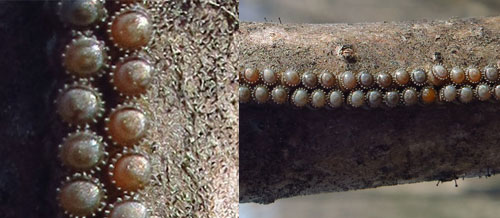
Egg: The egg is approximately 1 mm in diameter, with long projections around the operculum that are especially characteristic of Podisus spp. Eggs are laid 17 to 70 at a time in lines or loose oval masses.
Figure 2. Eggs of the spined soldier bug, Podisus maculiventris (Say). Photograph by Veronika Ronkos.
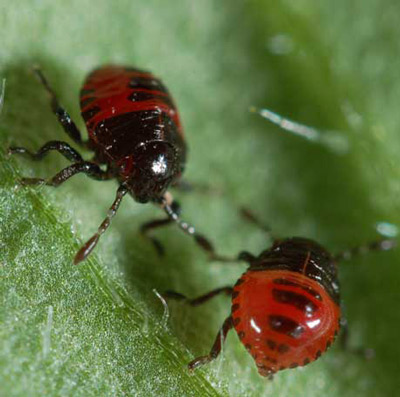
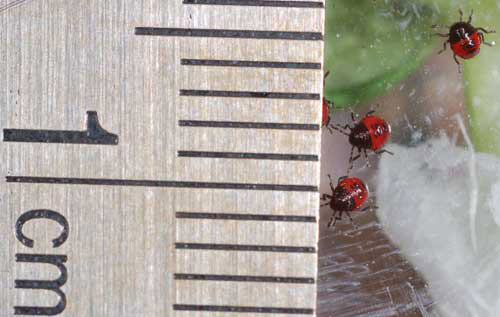
1st instar: This instar has a length of 1.3 to 1.5 mm. The head width, including the eyes, is 0.6 mm and the humeral width is 0.9 mm. The 1st instar nymph of Podisus maculiventris has a blackish head and thorax and reddish abdomen with black dorsal and lateral plates.
Figure 3. First instar nymphs of the spined soldier bug, Podisus maculiventris (Say). Photograph by Michael R. Patnaude.
Figure 4. Size of first instar nymphs of the spined soldier bug, Podisus maculiventris (Say). Photograph by Michael R. Patnaude.
2nd instar: This instar has a length of 2.5 to 3.0 mm. The head width is 0.9 mm and the humeral width is 1.3 mm. As in other asopine nymphs, the 2nd instar nymph feeds on other insects. This species is highly cannibalistic. The 2nd instar resembles the 1st instar.
Figure 5. Second instar nymph of the spined soldier bug, Podisus maculiventris (Say). Photograph by Michael R. Patnaude.
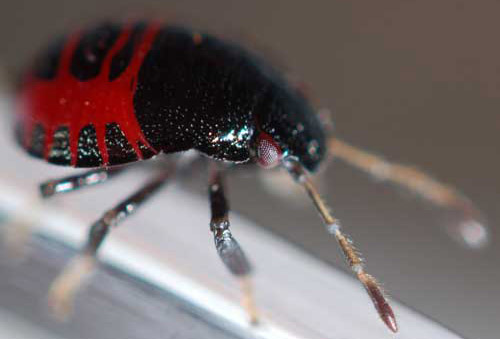
3rd instar: This instar has a length of 3.5 to 4. 0 mm. The head width is 1.3 mm and the humeral width is 2.0 mm. The 3rd instar nymph has a black head and thorax while the abdomen is reddish with black, orange and white maculations (markings). The central bar-shaped markings are white and the lateral markings are orange.
Figure 6. Third instar nymph of the spined soldier bug, Podisus maculiventris (Say). Photograph by Michael R. Patnaude.
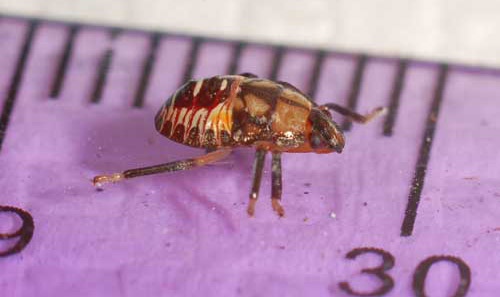
4th instar: This instar has a length of approximately 6 mm. The head width is 1.7 mm and the humeral is 3.2 mm wide. The colorations and patterns of the 4th instar nymph are similar to that of the 3rd instar nymph, but the wing pads become noticeable.
Figure 7. Fourth instar nymph of the spined soldier bug, Podisus maculiventris (Say). Photograph by Michael R. Patnaude.
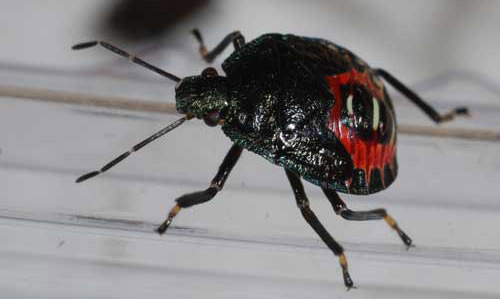
5th instar: This instar has a length of 8 to 10 mm. The head width is 2.2 mm and the humeral width is 4.8 mm. The wing pads are prominent in the 5th instar, and the head and thorax become mottled with brown. The abdominal markings are white or tan, and black.
Figure 8. Fifth instar nymph of the spined soldier bug, Podisus maculiventris (Say). Photograph by Michael R. Patnaude.
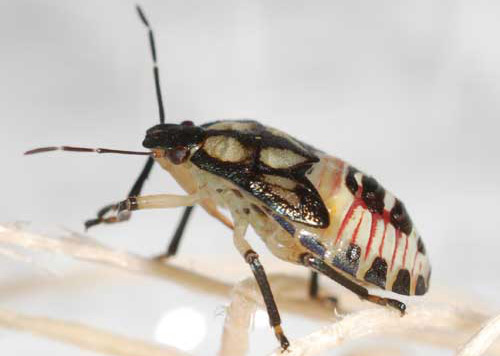
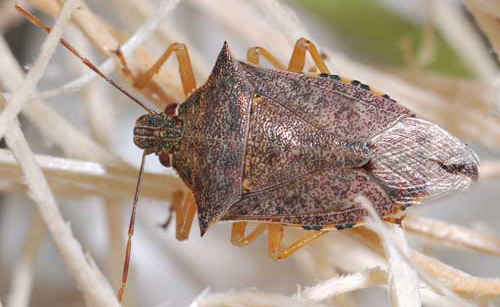
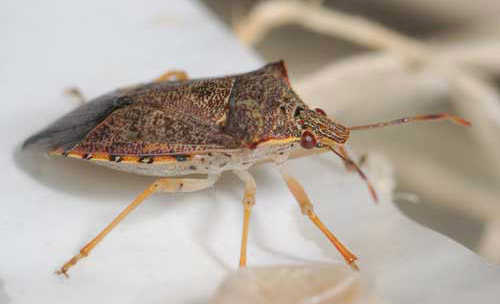
Adult: The adult male is approximately 11 mm long. The head width is 2.3 mm and the humeral width, including spines, is 7.6 mm wide. Females are slightly larger (De Clercq 2008). Adult Podisus maculiventris resemble the adult Alcaeorrhynchus grandis (Dallas) in being mottled brown in color, but Alcaeorrhynchus grandis adults are over 15 mm long and have only one spine on each humeral angle. These spines project outward, not forward as in Podisus macronatus Uhler. Each hind femur of Podisus maculiventris has two blackish dots at apical 3rd.
Figure 9. Dorsal view of a spined soldier bug, Podisus maculiventris (Say). Photograph by Michael R. Patnaude.
Figure 10. Front lateral view of a spined soldier bug, Podisus maculiventris (Say). Photograph by Michael R. Patnaude.
Life Cycle (Back to Top)
Kirkland (1896), Stoner (1930), Esselbaugh (1949), Mukerji and LeRoux (1965), Warren and Wallis (1971) and Richman and Whitcomb (1978) reported on the rearing of Podisus maculiventris. Their studies differed markedly in temperatures and photoperiods, consequently the time from egg to adult varied from 27 to 38 days, with the egg stage lasting five to nine days. The shortest time was reported for Florida specimens (Richman and Whitcomb 1978). Reported longevities for adults are from one to four months (De Clercq 2008).
Early instars are highly gregarious and usually remain in the same location. However, they become more solitary with each molt.
Food consumption, prey size, and energetics of Podisus maculiventris were detailed by Mukerji and LeRoux (1969a, b, c). The work by Couturier (1938) is a landmark study on the bionomics of this bug. Records in the Florida State Collection of Arthropods indicate that Podisus maculiventris is active all year in peninsular Florida, but often does not appear until spring in the "panhandle" counties. In Canada and the northern or central U.S., the spined soldier bug usually has two to three generations per year and hibernates as an adult from October to April (De Clercq 2008).
Economic Importance (Back to Top)
This insect is a generalist predator with a broad host range, reportedly attacking 90 insect species over eight orders (De Clercq 2008), including several important economic pests. Reported prey include the larvae of Mexican bean beetle, European corn borer, diamondback moth, corn earworm, beet armyworm, fall armyworm, cabbage looper, imported cabbageworm, Colorado potato beetle, velvetbean caterpillar, and flea beetles (Hoffmann and Frodsham 1993). When prey are scarce, the spined soldier bug may feed on plant juices, but this feeding is not reported to cause plant damage (De Clercq 2008).
Podisus maculiventris is associated with several crops including alfalfa, apples, asparagus, beans, celery, cotton, crucifers, cucurbits, eggplant, onions, potatoes, soybeans, sweet corn and tomatoes (Stoner 1930, Hayslip et al. 1953, Whitcomb 1973, Deitz et al. 1976, Hoffmann and Frodsham 1993).
The effectiveness of this species in preying on economic pests resulted in its use in classical biological control programs in other countries, including Eastern Europe and Russia. However, this has not been successful in colder climates, perhaps due to this species’ inability to overwinter. Podisus maculiventris eggs are also sold commercially for use in control programs and this has proven successful in controlling pests in European and North American heated greenhouses. Use in large area field crops is often not economically viable due to the production costs of raising the bug. In addition, naturally occurring populations often are not numerous enough to overpower large populations of pests in the spring. Pheromones have been used to draw natually occurring and newly emerging populations of this stink bug to target crops in the spring (De Clercq 2008).
Selected References (Back to Top)
- Costello SL, Pratt PD, Rayachhetry MB, Center TD. 2002. Morphology and life history characteristics of Podisus mucronatus (Heteroptera: Pentatomidae). Florida Entomologist 85: 344-350.
- Couturier A. 1938. Contribution a l'étude biologique de Podisus maculiventris Say, prédateur américain du doryphore. Ann. Epiph. Phytogén. (n.s.) 4: 95-165.
- De Clercq P, Wyckhuys KW, De Oliveira HN, Klapwijk JK. 2002. Predation by Podisus maculiventris on different life stages of Nezara viridula. Florida Entomologist 85: 197-202.
- De Clercq P. 2008. Spined soldier bug, Podisus maculiventris Say (Hemiptera: Pentatomidae: Asopinae). pp. 3508-3510. In Capinera JL. (editor.) Encyclopedia of Entomology, Vol 4. Springer, Heidelberg.
- Deitz LL, Van Duyn HW, Bradley Jr JR, Rabb RL, Brooks WM, Stinner RW. 1976. A Guide to the Identification and Biology of Soybean Arthropods in North Carolina. North Carolina Agricultural Experiment Station Technical Bulletin 238: 1-264.
- Esselbaugh CO. 1949. Notes on the bionomics of some Midwestern Pentatomidae. Entomologica Americana (n.s.) 28: 1-73.
- Hayslip NE, Genung WG, Kelsheimer EG, Wilson JW. 1953. Insects attacking cabbage and other crucifers in Florida. Florida Agricultural Experiment Station Research Bulletin 534: 1-57.
- Herrick NJ, Reitz SR. 2004. Temporal occurrence of Podisus maculiventris (Hemiptera: Heteroptera: Pentatomidae) in North Florida. Florida Entomologist 87: 587-590.
- Hoffmann MP, Frodsham AC. 1993. Natural Enemies of Vegetable Insect Pests. Cornell University, Ithaca, NY. 63 pp.
- Kirkland AH. 1896. Predaceous Hemiptera-Heteroptera, pp, 392-403. In Forbush EH, Fernald CH (eds.). The Gypsy Moth, Porthetria dispar (Linn.). Wright and Potter Printing Co., State Printers, Boston, Mass.
- Mukerji MK, LeRoux EJ. 1965. Laboratory rearing of a Quebec strain of the pentatomid predator, Podisus maculiventris (Say) (Hemiptera: Pentatomidae). Phytoprotection 46: 40-60.
- Mukerji MK, LeRoux EJ. 1969a. The effect of predator age on the functional response of Podisus maculiventris to the prey size of Galleria mellonella. Canadian Entomologist 101: 314-327.
- Mukerji MK, LeRoux EJ. 1969b. A quantitative study of food consumption and growth of Podisus maculiventris (Hemiptera: Pentatomidae). Canadian Entomologist 101: 387-403.
- Mukerji MK, LeRoux EJ. 1969c. A study of energetics of Podisus maculiventris (Hemiptera: Pentatomidae). Canadian Entomologist 101: 449-460.
- Richman DB, Whitcomb WH. 1978. Comparative life cycles of four species of predatory stink bugs (Hemiptera: Pentatomidae). Florida Entomologist 61: 113-119.
- Stoner D. 1930. Spined soldier-bug reared on celery leaf-tyer. Florida Entomologist 14: 21-22.
- Warren LO, Wallis G. 1971. Biology of the spined soldier bug, Podisus maculiventris (Hemiptera: Pentatomidae). Journal of the Georgia Entomological Society 6: 109-116.
- Whitcomb WH. 1973. Natural populations of entomophagous arthropods and their effects on the agroecosystem. Proceedings of the Mississippi Symposium of Biogical Control. University Press of Mississippi. pp. 150-169.