common name: a citrus blackfly parasitoid
scientific name: Encarsia perplexa Huang & Polaszek (Insecta: Hymenoptera: Aphelinidae)
Introduction - Distribution - Description - Life Cycle - Hosts - Selected References
Introduction (Back to Top)
Encarsia perplexa Huang & Polaszek is one of the most effective parasitoids of the citrus blackfly, Aleurocanthus woglumi Ashby (Hemiptera: Aleyrodidae). It was originally misidentified as Encarsia opulenta (Silvestri), but was later determined to be a new species (Huang and Polaszek 1998).
In 1950, Encarsia perplexa from Saharanpur (India) were released for the control of Aleurocanthus woglumi in Mexico (Flanders 1969). The parasite was then introduced to Texas in 1971 (Summy et al. 1983), and Florida in 1976 (Hart et al. 1978) to suppress and maintain under the economic threshold the population of the citrus blackfly in these states.
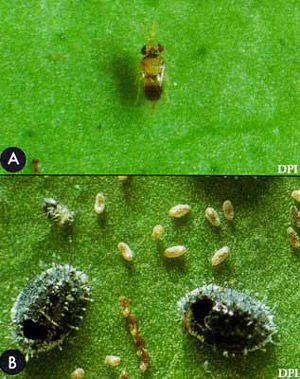
Figure 1. A) Adult Encarsia perplexa Huang & Polaszek; and (B) pupal cases of the citrus blackfly, Aleurocanthus woglumi Ashby, from which parasitoids have emerged (see roundish black holes). Normal emergence of an adult blackfly would leave a T-shaped split in the pupal case. Photograph by Division of Plant Industry.
Distribution (Back to Top)
Encarsia perplexa is reported as native to Asia (Vietnam and India) (Silvestri 1927, Smith et al. 1964, (Huang and Polaszek 1998), and was introduced to Barbados, Cuba, Salvador, Kenya, Jamaica, Oman, Mexico, Venezuela, and the USA (Texas and Florida) to control the citrus blackfly. In Florida, the parasite is found in south and central Florida where citrus blackfly occurs (Nguyen et al. 1983).
Description (Back to Top)
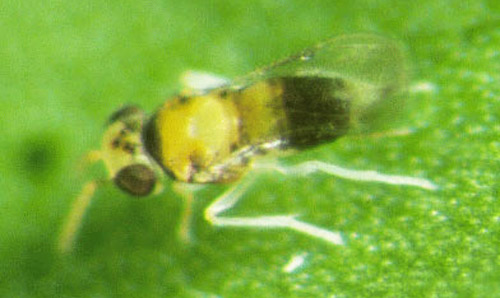
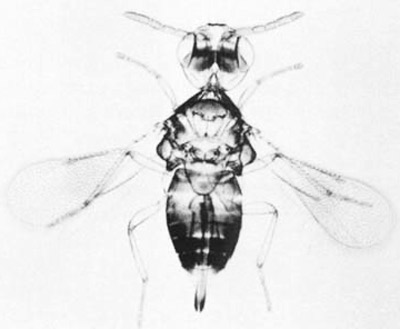
The females are small (1.10 mm long) with the thorax whitish to pale yellowish. The antennae are 0.8 mm long, 8-segmented, and the 1st flagellum is shorter than the pedicel or other flagella. The wings are slightly shady in the center. Abdomenial segments 3 to 6 dark brown, with the remainder being yellowish. Ovipositors are dark and 0.5 mm long.
Figure 2. Adult female Encarsia perplexa Huang & Polaszek. Photograph by Ron Heu and Walter Nagamine, Hawaiian Department of Agriculture.
Figure 3. Adult female Encarsia perplexa Huang & Polaszek. Photograph by Division of Plant Industry.
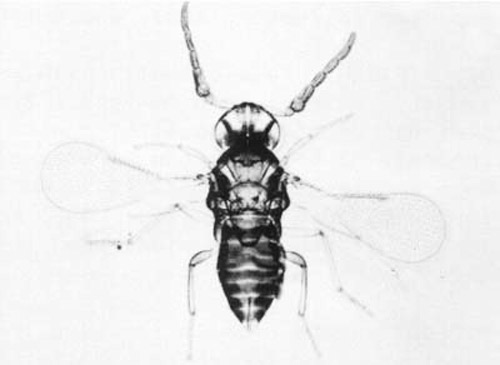
Male Encarsia perplexa are smaller than females, with males averaging 0.75 mm long and are different in color. The body and head of the males is dark brown. Male antennae are 8-segmented, with the 1st flagellum almost round and wider than the succeeding segment (Silvestri 1927, Grissell 1979).
Figure 4. Adult male Encarsia perplexa Huang & Polaszek. Photograph by Division of Plant Industry.
Life Cycle (Back to Top)
The female can live longer than 30 days with adequate nutrition and displays good searching ability. A mated female lays a single diploid egg in any nymphal stage of the citrus blackfly, but prefers the second stage, and this egg will produce a female. Under laboratory conditions (24°C) the development from egg to adult requires 30 to 35 days. Virgin females lay haploid eggs in the fully developed larva of the Encarsia perplexa female (their own species) and thereby produce males (adelpho-parasite). The sex ratio in the field is about 1:7 (male:female). Encarsia perplexa is hyperparasitized by Encarsia smithi (Silvestri) which was accidentally introduced to Florida by 1979.
In Florida, Encarsia perplexa and Amitus hesperidum (Hymenoptera: Platygastidae) coexist. The latter has a high rate of reproduction, and can produce 60 to 70 progeny per female making this species very effective in suppressing high densities of the citrus blackfly. Encarsia perplexa reproduces very slowly, but effectively limits Aleurocanthus woglumi when populations are at a low level in Florida (Nguyen et al. 1983, Nguyen and Sailer 1987, and Flanders 1969).
Hosts (Back to Top)
Aleurocanthus woglumi Ashby and Aleurocanthus incertus Silvestri are the only hosts reported (Silvestri 1927, Smith et al. 1964). When the adult parasitoid emerges from the blackfly pupal case, it leaves a roundish black hole. Normal emergence of an adult blackfly would leave a T-shaped split in the pupal case.
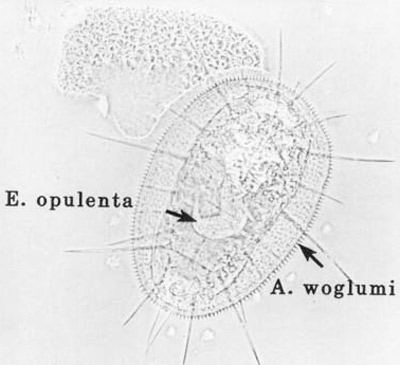
Figure 5. A larva of Encarsia perplexa Huang & Polaszek in a nymph of the citrus blackfly, Aleurocanthus woglumi Ashby. Encarsia perplexa was originally misidentified as Encarsia opulenta (Silvestri), but was later determined to be Encarsia perplexa. Photograph by Division of Plant Industry.
Selected References (Back to Top)
- Flanders SE. 1969. Herbert D. Smith's observations on citrus blackfly parasites in India and Mexico and the correlated circumstances. Canadian Entomologist 101: 467-480.
- Grissell EE. 1979. The Prospaltella of Florida (Hymenoptera: Aphelinidae). Florida Department of Agriculture and Consumer Services, Division of Plant Industry Entomology Circular 203.
- Hart WG, Selhime A, Harlan DP, Ingle SJ, Sanchez RM, Rhode RH, Garcia CA, Caballero J, Garcia RL. 1978. The introduction and establishment of parasites of citrus blackfly, Aleurocanthus woglumi in Florida (Homoptera: Aleyrodidae). Entomophaga 23: 361-366.
- Heu RA, Nagamine WT. (June 2001). Citrus blackfly, Aleurocanthus woglumi Ashby (Homoptera: Aleyrodidae). State of Hawaii, Department of Agriculture. http://hawaii.gov/hdoa/pi/ppc/npa-1/npa99-03_citrusbf.pdf.
- Huang J, Polaszek A. 1998. A revision of the Chinese species of Encarsia Forster (Hymenoptera: Aphelinidae): parasitoids of whiteflies, scale insects and aphids (Hemiptera: Aleyrodidae, Diaspididae, Aphidoidea). Journal of Natural History 32: 1825-1966.
- Nguyen Ru, Brazzel JR, Poucher C. 1983. Population density of the citrus blackfly, Aleurocanthus woglumi Ashby (Homoptera: Aleyrodidae), and its parasites in urban Florida in 1979-1981. Environmental Entomology 12: 878-884.
- Nguyen Ru, Brazzel JR, Poucher C, Sailer RI. 1987. Facultative hyperparasitism and sex determination of Encarsia smithi (Silvestri) (Hymenoptera: Aphelinidae). Annals of the Entomological Society of America 80: 814-819.
- Silvestri F. 1927. Contribuzione alla conoscenza degli Aleurodidae (Insecta: Hemiptera) viventi su citrus in Extremo Oriente e dei loro parasiti. Boll. Lab. Zool. Portici. 21: 1-60.
- Smith HP, Maltby HL, Jimenez EJ. 1964. Biological control of the citrus blackfly in Mexico. U.S. Department of Agriculture Technical Bulletin No. 1311: 30 pp.
- Summy KR, Gilstrap FE, Hart WG, Caballero JM, Saenz I. 1983. Biological control of citrus blackfly (Homoptera: Aleyrodidae) in Texas. Environmental Entomology 12: 782-786.