common name: parasitoid of the citrus leafminer
scientific name: Cirrospilus ingenuus Gahan (Insecta: Hymenoptera: Eulophidae)
Introduction - Classical Biological Control of the Citrus Leafminer in Florida - Description of C. ingenuus - Biology of C. ingenuus - Selected References
Introduction (Back to Top)
The citrus leafminer, Phyllocnistis citrella Stainton, was first detected in Florida in 1993 and spread rapidly throughout the state. The citrus leafminer is now well established throughout the citrus-growing areas of Florida, Louisiana, Texas and southern California in the U.S.A.
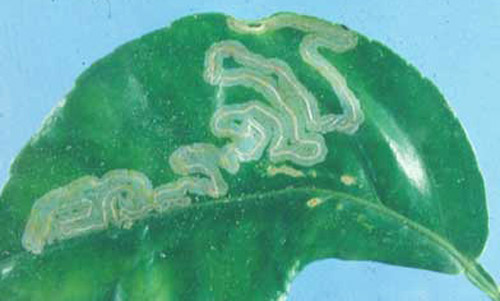
The citrus leafminer is a pest of citrus in Asia, apparently preferring citrus species and a few closely-related Rutaceae as hosts (Heppner 1993, Knapp et al. 1995). The citrus leafminer has a relatively simple life history. Adult males and females emerge in the early morning hours and mate at dusk, and females begin to deposit eggs about 24 hours later on tender young leaves 10 to 20 mm in length (also called flush) during the night. A single female can deposit approximately 50 eggs during her life. The eggs mature in within a day in summer and the young larva immediately chews its way into the leaf, where it burrows between the top and bottom layers. There are three larval stages, as well as a prepupal and pupal stage, on the leaf. The larvae produce characteristic silvery mines, and the prepupa produces silk to form a closed pupal chamber, which is usually located along the rolled edge of the leaf. Molting to the pupa occurs within this protected chamber and, after about six days, the adults emerge. Up to 15 generations per year can occur on flush under subtropical conditions (Smith et al. 1997). When citrus leafminer populations are at high densities, females may deposit eggs on fruit or stems, but the larvae rarely survive to adulthood.
Figure 1. A citrus leaf containing a single leafminer mine, showing the damage that can be done by citrus leafminer, Phyllocnistis citrella Stainton, feeding. Photograph by Jeff Lotz, FDACS-DPI.
Classical Biological Control of the Citrus Leafminer in Florida (Back to Top)
In Florida, a variety of endemic natural enemies attack the citrus leafminer. Several eulophid parasitoid species, already present in Florida when the citrus leafminer invaded, moved on to this new food source (Browning and Pena 1995, Pena et al. 1996, Schauff et al. 1998) and spiders, lacewings and ants also prey on them (Villanueva-Jiminez et al. 1998, Amalin and Pena 1999). Because it was unclear whether these generalist natural enemies could adequately suppress the citrus leafminer, a classical biological control program was initiated.
The classical biological control program was initiated because important natural enemies were known to occur in Asia and in Australia (Heppner 1993, Neale et al. 1995). In 1994, Ageniaspis citricola Logvinovskaya and Cirrospilus ingenuus Gahan were introduced from Australia; Cirrospilus ingenuus was called Cirrospilus quadristriatus at that time (Hoy and Nguyen 1994, 1997). Semielacher petiolatus (Girault) was introduced into quarantine from Australia at the same time but, because resources were limited, the S. petiolatus colony could not be maintained.
Ageniaspis citricola was released first and established rapidly, spreading throughout the state (Hoy and Nguyen 1994, 1997; Hoy et al. 1995, 1997; Pomerinke and Stansly 1998). Ageniaspis citricola is considered a specialist on the citrus leafminer and does not appear to attack other insects to any significant degree. As a result, when citrus leafminer population densities are low, Ageniaspis citricola has to search intensely for hosts. Because populations of both Ageniaspis citricola and the citrus leafminer decline over the winter in Florida due to a lack of flush, few are detected during the first major flush cycle; the second major flush cycle in Florida (in May) may have more leafminers than is desirable due to a lag in response by the host-specific Ageniaspis citricola population (Villanueva-Jimenez et al. 1998, Zappala et al., unpublished).
Cirrospilus ingenuus was the second introduced parasitoid to be released in 1994 in Florida (Hoy and Nguyen 1994, 1997; Smith and Hoy 1995). Monitoring of citrus leafminer populations throughout the state failed to detect Cirrospilus ingenuus after the releases (Hoy and Nguyen, unpublished), although it apparently did establish. LaSalle et al. (1999) reported Cirrospilus ingenuus recovered from the citrus leafminer in November 1997 and January 1998 in the Homestead area of Florida. Its presence in citrus groves outside the Homestead area has never been determined (Hoy and Nguyen, unpublished).
Description of Cirrospilus ingenuus (Back to Top)
Parasitoids in the genus Cirrospilus Westwood have 4-segmented tarsi and a funicle that is 2-segmented in both sexes (Schauff et al. 1998). The submarginal vein has three or more setae dorsally and a postmarginal vein is present, subequal in length to the stigmal vein. The scutellum has lateral lines, although these may be difficult to see (Schauff et al. 1998).
The genus Cirrospilus contains approximately 130 species that are parasites of lepidopterous and dipterous leafminers (Zhu et al. 2002). In addition to C. ingenuus, a number of Cirrospilus species attack the citrus leafminer, including: cinctiventris, diallus, jiangxiensis, longifasciatus, lyncus, nigriscutellaris, nigrivariegatus, phyllocnistis, pictus, variegatus, vittatus, sp. nr. lyncus, as well as undescribed species from Honduras, Argentina, Japan, and Colombia (Schauff et al. 1998).
Cirrospilus ingenuus has been called Scotolinx quadristriatus (Khan and Shafee 1980), then Cirrospilus quadristriatus (Subba Rao and Ramamani 1966). Subseqently, Evans (1999) synonymized Cirrospilus quadristriatus with Cirrospilus ingenuus Gahan, as reported in Schauff et al. (1998) and LaSalle et al. (1999).
Cirrospilus ingenuus Gahan is an Asian parasitoid of the citrus leafminer whose natural range includes Australia, China, India, Indonesia, Japan, Malaysia, Oman, Taiwan and Thailand (Schauff et al. 1998, Zhu et al. 2002). It was also introduced into Australia as Cirrospilus quadristriatus, into Cyprus and Israel as Cirrospilus quadristriatus, as well as Morocco, Oman, Syria, Tunisia, and Turkey (Schauff et al. 1998).
Biology of Cirrospilus ingenuus(Back to Top)
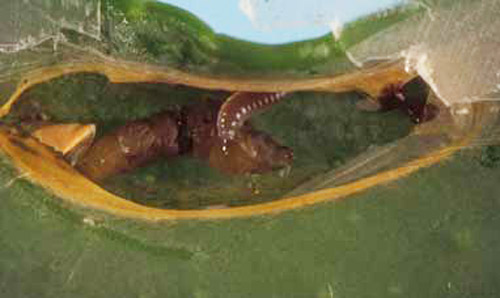
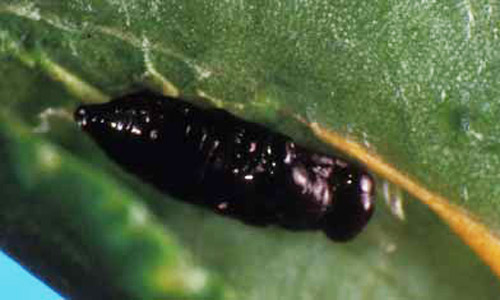
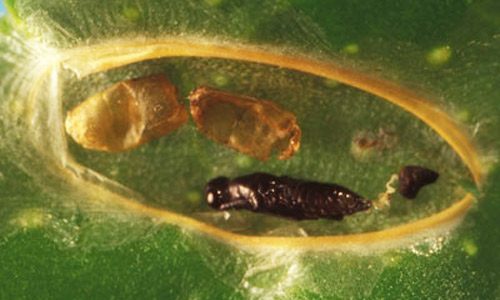
Cirrospilus ingenuus is an solitary ectoparasitoid of late-instar larvae or of the prepupae of the citrus leafminer. Cirrospilus ingenuus generally is considered to be restricted in its host range to the citrus leafminer. More than one egg may be deposited, but only one adult will emerge. Adults are primarily yellow and have red eyes. Eggs are deposited in the mine and larvae feed on the leafminer larva or prepupa. The parasitoid pupa is shiny black and emerges from the pupal chamber of its host. Any remains of the leafminer host that are not consumed are darkened. There is a female-biased sex ratio, with Ujiye and Adachi (1995) reporting approximately 60% female progeny. Adults live for as long as two weeks. A generation requires two to three weeks, depending on the temperature (Smith and Hoy 1995). Neale et al. (1995) reported that host feeding or probing with the ovipositor can result in some mortality of the leafminer host, but did not quantify this.
Figure 2. Adult Cirrospilus ingenuus Gahan is yellow. Photograph by Jeff Lotz, FDACS-DPI.
Figure 3. A Cirrospilus ingenuus Gahan larva is feeding on a citrus leafminer prepupa. The covering of the pupal chamber was removed for the photograph. Photograph by Jeff Lotz, FDACS-DPI.
Figure 4. The pupae of Cirrospilus ingenuus Gahan are black and are found within the pupal chamber of the citrus leafminer host. Photograph by Jeff Lotz, FDACS-DPI.
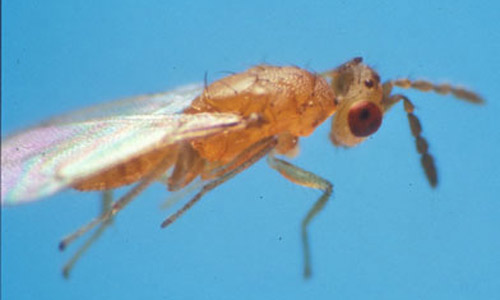
Subba Rao and Ramamani (1966) described Cirrospilus ingenuus females as 1.74 mm long and males as 1.15 mm in length and almost identical to the female in color. Females were described as yellow to brownish yellow, with a head pale yellow towards the proximal end and darker at the distal end. The antennae are brownish yellow and the thorax almost yellow. The abdomen is yellow with five brown transverse bands, four of which are complete and one which is incomplete. The wings are hyaline and the legs are pale yellow. The eyes are red.
Cirrospilus ingenuus (now synonymized with Cirrospilus quadristriatus) was imported from Asia and evaluated in quarantine in Australia to determine whether it had alternative hosts (Neale et al. 1995). Nineteen insect species were evaluated as potential hosts in quarantine, and none (including other gracillariid species) were parasitized by C. ingenuus (Neale et al. 1995).
However, recently Zhu et al. (2002) recorded Cirrospilus ingenuus parasitizing larvae and pupae of a different leafminer on citrus (Lyonetiidae), as well as on P. citrella. There could be errors in identification, but the incidence of parasitism in hosts other than the citrus leafminer appears to be low.
Laboratory observations indicate that Cirrospilus ingenuus will attack citrus leafminer larvae that have been parasitized by Ageniaspis citricola (Hoy and Nguyen 1997). As a result, Cirrospilus ingenuus could act as a facultative hyperparasitoid, although we have no data to indicate that it has done so in the field in Florida or that it prefers parasitized over unparasitized citrus leafminer hosts.
Figure 5. Laboratory observations indicate that Cirrospilus ingenuus Gahan could parasitize citrus leafminer larvae that were already parasitized by the endoparasitoid Ageniaspis citricola. As a result, it is possible that C. ingenuus could act as a facultative hyperparasitoid. Photograph by Jeff Lotz, FDACS-DPI.
As of October 2003, evaluations of the geographic distribution of Cirrospilus ingenuus in Florida and a quantitative assessment of Cirrospilus ingenuus as a natural enemy of the citrus leafminer in Florida have not been conducted because densities of Cirrospilus ingenuus appear to be very low (Hoy et al., unpublished). Because some natural enemies introduced in classical biological control programs take many years to increase in density, it is possible that Cirrospilus ingenuus could become more abundant in the future. Researchers working in citrus should be aware of the possibility that Cirrospilus ingenuus is present.
Selected References (Back to Top)
- Amalin DM, Pena JE. 1999. Predatory spiders in lime orchards and their importance in the control of citrus leafminer, Phyllocnistis citrella (Lepidoptera: Gracillariidae). Proceedings of the Florida State Horticultural Society 112: 222-224.
- Argov Y, Rossler Y. 1996. Introduction, release and recovery of several exotic natural enemies for biological control of the citrus leafminer, Phyllocnistis citrella, in Israel. Phytoparasitica 24: 33-38.
- Ateyyat MZ. 2002. Parasitoid complex of citrus leafminer, Phyllocnistis citrella on lemon in the Central Jordan Valley. BioControl 47: 33-43.
- Boucek Z. 1988. Australasian Chalcidoidea (Hymenoptera). A Biosystematic Revision of Genera of Fourteen Families, with a Reclassification of Species. Wallingford: CAB International.
- Browning H, Pena JE. 1995. Biological control of the citrus leafminer by its native parasitoids and predators. Citrus Industry 76: 46-48.
- Evans GA. 1999. A new species of Cirrospilus (Hymenoptera: Eulophidae) and two new synonymies of parasitoids reared from the citrus leafminer, Phyllocnistis citrella (Lepidoptera: Gracillariidae). Florida Entomologist 82: 448-453.
- Heppner JB. 1993. Citrus leafminer (CLM) Phyllocnistis citrella Stainton, in Florida (Lepidoptera: Gracillariidae: Phyllocnistinae). Tropical Lepidoptera 4: 49-64.
- Hoy MA, Nguyen R. 1994. Classical biological control of the citrus leafminer: release of Cirrospilus quadristriatus. Citrus Industry, November, p. 14.
- Hoy MA, Nguyen R. 1997. Classical biological control of the citrus leafminer Phyllocnistis citrella Stainton (Lepidoptera: Gracillariidae): Theory, practice, art, and science. Tropical Lepidoptera 8 (Suppl. 1): 1-19.
- Hoy MA, Nguyen R, Hall D, Pomerinke M, Pena J, Browning H, Stansly P. 1995. Establishment of citrus leafminer parasitoid. Ageniaspis citricola in Florida. Citrus Industry, December pp. 12- 17.
- Hoy M, Nguyen R, Pomerinke M, Bullock R, Hall D, Knapp J, Pena J, Browning H, Stansly P. 1997. Distribution and abundance of Ageniaspis citricola, a parasite of the citrus leafminer in Florida. Citrus Industry 78(5): 51-52.
- Knapp JL, Albrigo LG, Browning HW, Bullock RC, Heppner JB, Hall DG, Hoy MA, Nguyen R, Pena JE, Stansly PA. 1995. Citrus leafminer, Phyllocnistis citrella Stainton: Current Status in Florida - 1994. Florida Cooperative Extension Service, IFAS, University of Florida, Gainesville, 26 pp.
- LaSalle JR, Duncan RE, Pena JE. 1999. The recovery and apparent establishment of Cirrospilus ingenuus (Hymenoptera: Eulophidae) in Florida. Florida Entomologist. 82: 371-373.
- Neale C, Smith D, Beattie GAC, Miles M. 1995. Importation, host specificity testing, rearing and release of three parasitoids of Phyllocnistis citrella Stainton (Lepidoptera: Gracillariidae) in eastern Australia. Journal of the Australian Entomological Society 34: 343-348.
- Pena JE, Duncan R, Browning H. 1996. Seasonal abundance of Phyllocnistis citrella (Lepidoptera: Gracillariidae) and its parasitoids in south Florida citrus. Environmental Entomology 25: 698-702.
- Pomerinke MA, Stansly PA. 1998. Establishment of Ageniaspis citricola (Hymenoptera: Encyrtidae) for biological control of Phyllocnistis citrella (Lepidoptera: Gracillariidae) in Florida. Florida Entomologist 81: 361-372.
- Schauff ME, LaSalle J, Wijesekara GA. 1998. The genera of chalcid parasitoids (Hymenoptera: Chalcidoidea) of citrus leafminer Phyllocnistis citrella Stainton (Lepidoptera: Gracillariidae). Journal of Natural History 21: 1001-1056.
- Smith D, Beattie GAC, Broadley R, Editors. 1997. Citrus Pests and Their Natural Enemies: Integrated Pest Management in Australia. Queensland Department of Primary Industries.
- Smith JM, Hoy MA. 1995. Rearing methods for Ageniaspis citricola (Hymenoptera: Encyrtidae) and Cirrospilus quadristriatus (Hymenoptera: Eulophidae) released in a classical biological control program for the citrus leafminer Phyllocnistis citrella (Lepidoptera: Gracillariidae). Florida Entomologist 78: 600-608.
- Subba Rao and Ramamani. 1966. Biology of Cirrospiloideus phyllocnistoides (Narayanan) and description of a new species, Scotolinx quadristriata (Hymenoptera: Eulophidae) as parasites of Phyllocnistis citrella Stainton. Indian Journal of Entomology 27: 408-413.
- Ujiye T. 2000. Biology and control of the citrus leafminer, Phyllocnistis citrella Stainton (Lepidoptera: Gracillariidae) in Japan. Japan Agricultural Research Quarterly 34: 167-173.
- Ujiye T, Adachi I. 1995. Parasitoids of the citrus leafminer, Phyllocnistis citrella Stainton (Lepidoptera: Gracillariidae) in Thailand. Tropical Journal of Applied Entomology Zool. (Tokyo) 36: 253-255.
- Villanueva-Jimenez JA, Hoy MA. 1998. Toxicity of pesticides to the citrus leafminer and its parasitoid Ageniaspis citricola evaluated to assess their suitability for an IPM program in citrus nurseries. BioControl 43: 357-388.
- Zhu CD, LaSalle J, Huang DW. 2002. A study of Chinese Cirrospilus Westwood (Hymenoptera: Eulophidae). Zoological Studies 41: 23-46.